
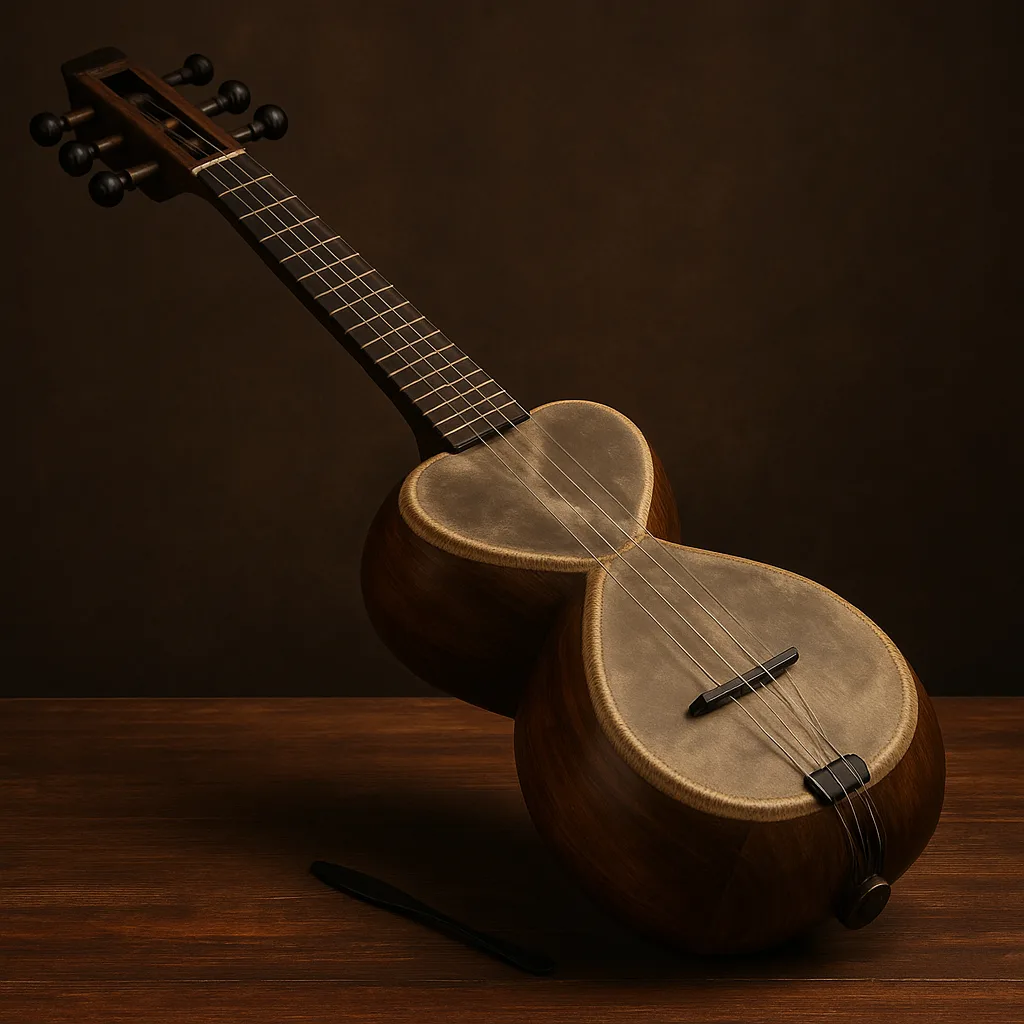
The Tar: Persian and Azerbaijani Long-Necked Lute
The tar covered here is the long-necked plucked lute used in Iranian and Azerbaijani musical traditions. It is unrelated to the tar frame drum, a separate membranophone found in parts of North Africa and the Arab world that happens to share the same name. The lute is known for its skin-covered double-bowl body, movable frets, clear attack, and central roles in Persian dastgāh and Azerbaijani mugham.
Historical and Cultural Significance
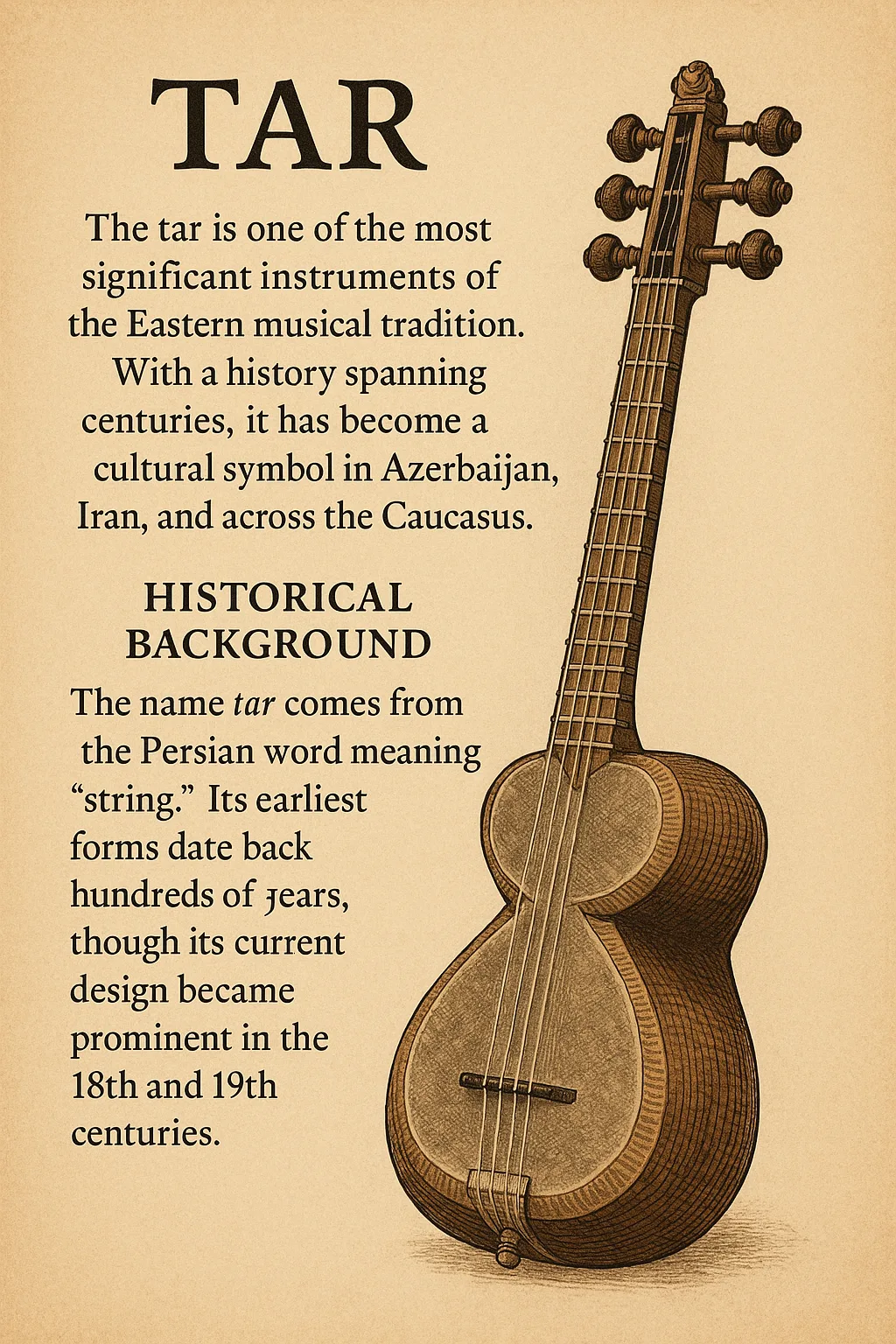
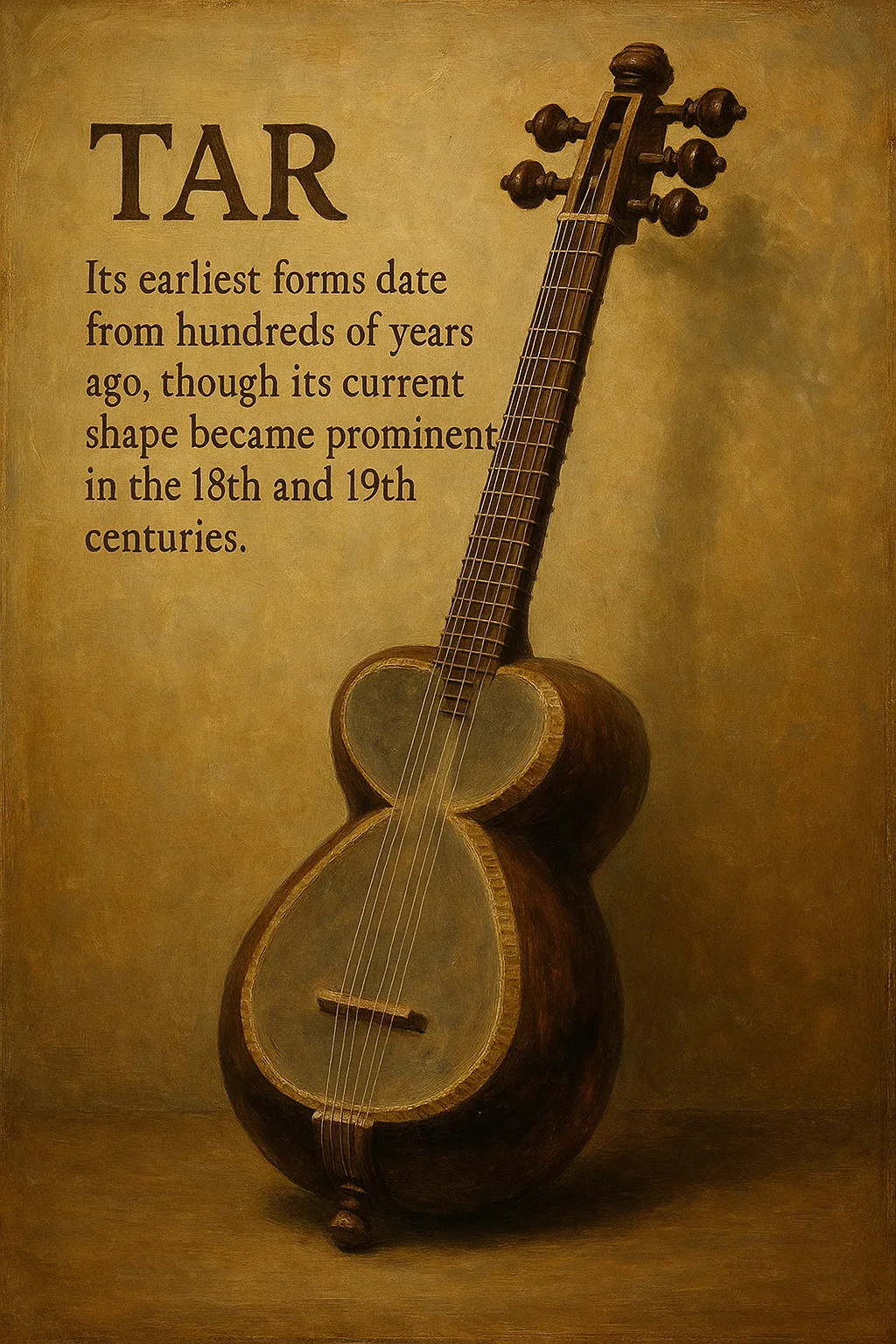
The word tar means “string” in Persian. The modern Persian tar developed from older long-necked lute traditions and became established in the form associated with Iranian classical music during the late 18th and 19th centuries. In Azerbaijan, the instrument underwent further changes during the 19th century. The musician and maker Sadigjan is closely associated with the development of the modern Azerbaijani tar, including changes to its stringing, construction, and playing position.
In Azerbaijan, the tar is a central voice in mugham; in Iran, it is closely connected with the radif and dastgāh tradition. In 2012, UNESCO inscribed “Craftsmanship and performance art of the Tar, a long-necked string musical instrument” for Azerbaijan on the Representative List of the Intangible Cultural Heritage of Humanity.
Instrument Anatomy: How Design Shapes Sound
Body & Membrane
The tar’s recognizable double-bowl, waisted body is typically carved from mulberry and covered with a thin skin membrane. Materials and construction details vary between Persian and Azerbaijani instruments and among individual makers. A bridge rests on the membrane and transfers string vibration into the skin-covered body, contributing to the instrument’s immediate attack and resonant response.
Neck, Frets, and Setup
The neck is often made from walnut or another stable hardwood. Movable tied frets, traditionally made from gut and also available in modern synthetic materials, allow players and makers to adjust fret placement for the intonation required by particular musical systems and repertories.
Action should be judged on the individual instrument rather than by one fixed measurement. String gauge, bridge height, neck condition, fret height, playing style, and regional setup all affect how much clearance works well.
Strings and Plectrum
Persian tars commonly use six strings arranged in three double courses. Modern Azerbaijani tars commonly use a larger stringing system, often with 11 strings serving melodic, drone, and resonant functions.
The tar is played with a plectrum, commonly called mezrāb or mizrab in regional terminology. Persian tar plectrums traditionally include small brass forms held in the right hand. Rapid alternating strokes produce riz, while changes in attack, angle, and force allow a wide range of articulation.
Persian and Azerbaijani Variants: A Side-by-Side View
| Feature | Persian Tar | Azerbaijani Tar | Notes |
|---|---|---|---|
| Body | Waisted double-bowl body, usually mulberry | Related waisted body with proportions shaped by Azerbaijani construction traditions | Both use a skin-covered resonating surface |
| Soundboard | Thin skin membrane | Thin skin membrane | Material and tension vary by maker and setup |
| Scale length | Varies by maker and instrument | Varies by maker and regional design | Measure the individual instrument before choosing strings |
| Frets | Movable tied frets | Movable tied frets | Positions reflect the intonation system and repertoire |
| Strings | Usually 6 in 3 double courses | Common modern form uses 11 strings | Azerbaijani construction includes additional drone and resonant functions |
| Tuning | Varies with dastgāh, school, and repertoire | Varies with mugham, performer, and setup | No single tuning covers every tradition |
| Primary traditions | Iranian dastgāh / radif | Azerbaijani mugham | Improvisation and modal phrasing are important in both |
Tuning, Range, and Core Techniques
There is no single universal tar tuning because setup changes with regional tradition, mode, repertoire, performer, and instrument. Persian tar uses three principal double courses, while the additional strings of the Azerbaijani tar provide a different tuning structure and resonant possibilities. Players should match string gauges and tuning to the specific tar rather than assume that a tuning intended for one variant is safe for another.
- Riz (tremolo): Rapid alternating plectrum strokes create a sustained melodic line from repeated attacks.
- Hammer-ons & pull-offs: Left-hand articulation connects notes without requiring a separate plectrum stroke for every pitch.
- Slides & vibrato: Controlled pitch movement adds ornamentation and modal expression.
- Cross-string ornaments: Alternating neighboring courses creates rhythmic and melodic articulation across the instrument.
Learning Path: From First Notes to Improvisation
Beginners typically start with posture, controlled plectrum strokes, basic fingering, and an established fret setup before moving deeper into the modal intonation and ornamentation of dastgāh or mugham. Because the tied frets can be adjusted, ear training remains important. Students learn characteristic intervals through listening, repetition, repertoire, and correction from an experienced player.
Traditional teacher-student instruction remains common, while conservatories and online materials can provide additional technical support. Persian and Azerbaijani tar technique should not be treated as interchangeable; posture, plectrum handling, stringing, and repertoire differ enough that learners benefit from material intended for the specific tradition they want to study.
Buying Guide: What to Check
- Identify the type first: Confirm whether the instrument is a Persian tar or an Azerbaijani tar. Stringing, dimensions, technique, and setup differ.
- Wood & build: Check the bowls, neck joint, pegbox, and carved body for active cracks, separating repairs, or distortion.
- Membrane: Look for secure seating, tears, damaged areas, excessive looseness, or uneven deformation around the bridge.
- Frets: They should be securely tied and positioned for the tuning and musical school in which the instrument will be used.
- Neck & action: Check for twisting, excessive string height, buzzing, and uneven response rather than relying on one universal action measurement.
- Bridge: Make sure it sits securely and appropriately on the membrane without obvious tilting or structural damage beneath it.
- Pegs & strings: Pegs should turn controllably and hold tuning. String gauges should match the instrument’s scale, tuning, and construction.
- Playing position: Persian and Azerbaijani traditions use different holding practices, so comfort should be judged according to the tar type being purchased.
- Provenance: For older or collectible instruments, ask about maker, age, repairs, membrane replacement, fret replacement, and other restoration work.
Care & Maintenance
The tar combines wood, skin, tied frets, glue joints, and metal strings, so abrupt environmental changes can affect several parts at once. Stable indoor conditions are preferable to chasing one exact humidity number.
Very dry conditions can tighten skin and stress wooden parts or joints. High humidity can soften or slacken the membrane and alter response. Avoid radiators, direct heating, prolonged sunlight, damp storage areas, and rapid temperature changes.
Wipe strings and contact areas gently after playing. Replace strings when they become corroded, unstable, or unsuitable for reliable intonation. If the membrane tears, loosens severely, or needs replacement, use a repairer familiar with tar construction because membrane material and tension directly affect bridge position, action, and sound.
Recording & Amplification Tips
- Microphone placement: Start with a small-diaphragm condenser or another suitable instrument microphone at a moderate distance from the skin-covered body. Move it gradually while listening for the balance between plectrum attack and body resonance.
- Avoid aiming directly at one harsh point: Slightly off-axis positioning can reduce excessive plectrum noise while preserving articulation.
- Stage amplification: A pickup can improve gain before feedback, but its response depends strongly on placement and the individual instrument. Use EQ only after identifying the resonant frequencies causing problems.
- Microphone and pickup blend: When using both, begin with the microphone as the natural reference and add pickup signal only as needed for level, isolation, or feedback control.
Notable Artists and Repertoire
Azerbaijani masters such as Bahram Mansurov and Ramiz Guliyev are closely associated with Azerbaijani tar performance, while Iranian musicians such as Ali-Akbar Shahnazi played an important role in transmitting and developing Persian tar repertoire and technique. Recordings by established performers are useful references for plectrum articulation, phrasing, ornamentation, and modal practice.
Modern Ensembles and Cross-Genre Collaborations
Beyond classical repertoire, tar appears in orchestral projects, chamber ensembles, recordings, and collaborations with instruments such as kamancheh, percussion, and Western ensemble instruments. Contemporary musicians also use the tar in jazz, fusion, experimental composition, and other cross-genre settings.
The Persian and Azerbaijani tar share a long-necked, skin-covered lute ancestry but have developed distinct construction details, stringing systems, playing positions, techniques, and repertories. Identifying the variant correctly is important when choosing strings, learning technique, arranging repairs, or describing an older instrument. The unrelated tar frame drum belongs to a different instrument family and should be cataloged separately.