
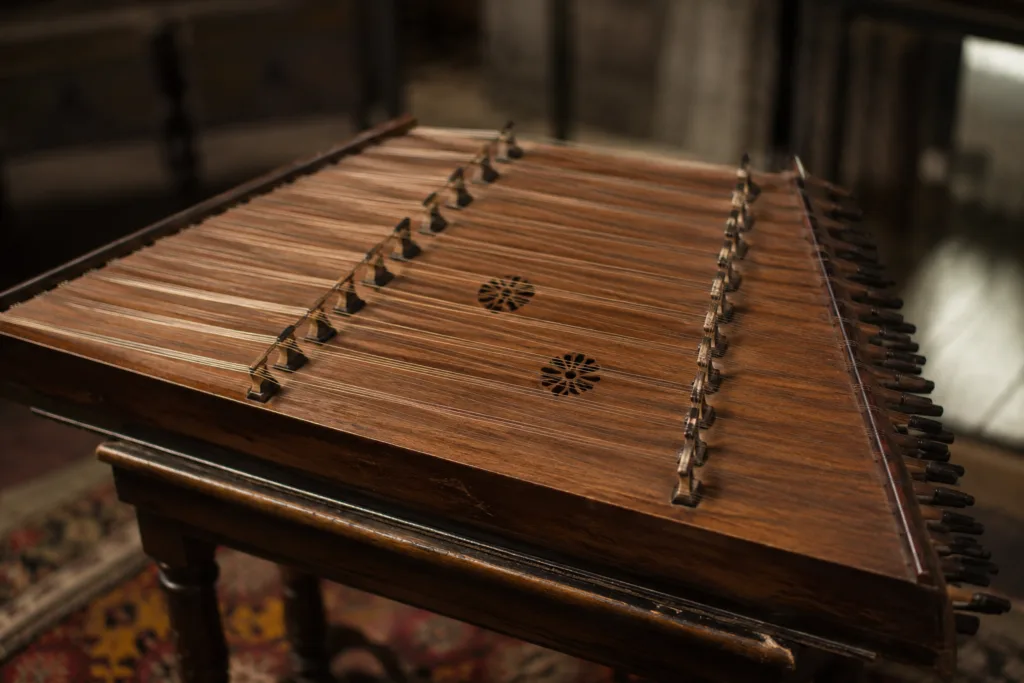
Strike one course of a santur and the sound does not behave like a plucked string. It blooms fast, throws a bright edge into the room, then thins into a silver-like shimmer. That short life of the note is part of the instrument’s charm. The wooden body, metal strings, movable bridges, and feather-light mallets all work together, and a small change in any one of them can alter the voice more than a casual listener expects.
| Feature | Typical Detail | Why It Matters |
|---|---|---|
| Instrument Family | Struck zither; hammered dulcimer family | The strings are sounded by mallets, not by bowing or plucking. |
| Body Shape | Shallow trapezoid box | The wider bass side gives lower strings more air and surface response. |
| Persian Santur Layout | Often 72 strings, 18 bridges, four strings per course | Four strings tuned together create the familiar chorused sparkle. |
| Indian Santoor Layout | Often around 100 strings with more bridges | It supports a broader melodic surface and a different playing approach. |
| Common Woods | Walnut, sometimes maple or other seasoned hardwoods | Wood choice affects warmth, sustain, attack, and tuning behavior. |
| Playing Tools | Mezrab, zahme, or kalam depending on tradition | Mallet weight and tip shape change the first flash of the note. |
Collector’s Note: A good santur should not only sound bright. Listen for evenness across the courses. If the bass speaks warmly but the upper register turns thin or glassy, the bridge height, stringing, or soundboard balance may need attention.
What Makes the Santur Different
- It is a string instrument with a percussive attack. The note begins with a clear strike, then opens into resonance.
- It uses courses of strings. Several strings share one pitch, which gives the sound a soft, rippling edge.
- Its bridges are part of the voice. They are not only supports; they shape length, tension, brightness, and tuning response.
- Its tone changes with small setup differences. A lighter mallet, a shifted bridge, or a drier room can change the feel under the hands.
The santur sits between melody and rhythm. It can play flowing lines, but every tone begins with a clear mallet attack. That transient gives the instrument much of its articulation, while the grouped strings provide the resonance that follows.
Unlike a harp or qanun, the santur does not ask the finger to pull the string. Unlike a piano, it has no keyboard, no dampers in the common traditional setup, and no hidden action between hand and string. The player’s wrist, the mezrab, the bridge, and the string respond almost at once.
The Word Santur, Santoor, and Santour
The spellings santur, santoor, and santour often point to related instruments in different languages and musical settings. In Persian classical music, santur is common. In Indian classical music, santoor is the usual English spelling. Some makers and players use santour, especially in Middle Eastern and European writing.
The names are close, but the instruments are not always identical. A spelling difference can accompany real changes in string count, bridge layout, tuning system, mallet shape, and repertoire.
Body Shape, Wood, and the Santur’s Voice
A santur body looks simple from above: a shallow trapezoid with strings running across it. On the workbench, it is more demanding. The soundboard must be stiff enough to carry string tension while remaining responsive to light mallet strikes. Excessive stiffness can produce a dry response, while weak support can blur articulation and create structural problems.
Many traditional instruments use seasoned hardwood, with walnut common in Persian and Kashmiri santoor making. Other woods also appear according to regional craft, maker preference, and the function of each part.
The back and sides matter too. Body weight, soundboard thickness, internal support, joints, bridge loading, and wood condition all contribute to response. Wood species alone cannot predict the final sound.
Walnut Body vs. Lighter Woods
| Material Choice | Typical Sound Tendency | Practical Consideration |
|---|---|---|
| Walnut | Often associated with a warm body and clear attack | Common in several regional santur and santoor-making traditions. |
| Maple | Can provide a firm, clearly articulated response depending on construction | Used by some contemporary makers and in individual instrument parts. |
| Other Seasoned Woods | Response varies with density, thickness, grain, and the part being made | Should be judged as part of the full structure rather than by species name alone. |
Wood alone does not make a fine santur. The grain direction, drying, soundboard thickness, internal structure, bridge contact, and string pressure all matter. A plain-looking instrument can sound excellent if its structure is stable and well voiced.
Player Tip: When testing a santur, play the same simple figure in the low, middle, and high registers. The character can change across the range, but weak courses, abrupt tonal shifts, or an excessively harsh upper register deserve closer inspection.
Strings, Bridges, and Why the Sound Shimmers
The santur’s shimmer comes partly from courses of strings tuned to the same pitch. On many Persian santurs, each course has four strings. Small differences in tension and vibration between those strings produce audible beating within the combined tone.
This slight beating is a normal part of the instrument’s timbre when the course is otherwise properly tuned.
Brass, Bronze, and Steel Courses
Many santurs use yellow-metal strings in lower registers and steel strings in higher courses. Exact materials and layouts vary by maker and regional tradition. String alloy, gauge, speaking length, and tension all affect the balance between warmth, brightness, sustain, and mallet response.
The transition between different string materials should remain musically coherent across the instrument. Abrupt changes in tone can come from string choice, bridge setup, uneven tension, or the instrument’s own resonant balance.
The Bridge Has Several Acoustic Jobs
The bridges, often called kharak in Persian contexts, divide string lengths and transfer vibration into the body. Their feet must sit cleanly. Height influences down-pressure, position changes speaking length, and mass affects how string energy reaches the soundboard.
A bridge that leans, rocks, or contacts the soundboard unevenly can weaken a course or create unwanted noise.
- Bridge height changes down-pressure on the soundboard.
- Bridge position changes speaking string length and pitch.
- Bridge mass changes how vibration transfers into the body.
- Bridge foot contact affects clarity, sustain, and unwanted buzzing.
Collector’s Note: A vintage santur with original bridges can be attractive, but bridge condition matters more than age alone. Check for warped pieces, poor contact, split wood, and uneven spacing. These details affect both tone and tuning.
Mezrab, Zahme, and the First Touch of the Note
The santur’s mallets are light, narrow, and highly sensitive to small changes in motion. In Persian playing, they are commonly called mezrab or zahme. In Indian santoor contexts, kalam is also used. Shapes, weights, and playing surfaces differ according to tradition and player preference.
Harder contact produces a more pronounced transient. Wrapped or softer striking surfaces reduce some high-frequency attack and can give the tone a rounder start.
Much of the motion comes from the wrist. Excessive arm weight can make articulation hard and uneven, while relaxed rebound supports quick repeated strokes.
Bare Wood vs. Wrapped Tips
| Mallet Type | Sound Character | Player Feel |
|---|---|---|
| Bare Wood | Clear, bright, articulate | Fast response and a clearly exposed attack. |
| Lightly Wrapped | Softer edge, rounder attack | Reduces some of the hard transient on bright instruments. |
| Heavier or Softer Tips | Less metallic brightness, greater cushioning | Can reduce definition if paired with an already mellow instrument. |
Changing mallets can alter articulation enough to make a familiar instrument feel different under the hand. For a collector, a matched pair of original or well-made mezrabs also adds practical value.
Persian Santur vs. Indian Santoor
The Persian santur and Indian santoor are related struck zithers, but their construction and musical use are not identical. String count, bridge arrangement, tuning practice, repertory, and mallet technique should all be considered when identifying or buying an instrument.
| Feature | Persian Santur | Indian Santoor |
|---|---|---|
| Common String Count | Often 72 strings | Often around 100 strings, with maker and concert-layout variation |
| Bridge Layout | Often two rows of nine bridges | Usually more bridges; layouts vary among makers and playing traditions |
| Main Musical Setting | Persian classical music and related modal traditions | Kashmiri music and Indian classical concert performance |
| Mallet Name | Mezrab or zahme | Kalam in many Indian contexts |
| Playing and Tuning | Closely connected to Persian modal practice and characteristic bridge relationships | Adapted to Indian melodic development and concert technique |
The Persian santur generally uses a compact traditional layout adapted to Persian modal performance. The Indian santoor, especially in twentieth-century concert practice, developed a broader playing surface and construction suited to Indian classical melodic treatment.
Which One Should a Beginner Choose?
A beginner should choose according to the music they plan to study. For Persian classical repertoire, a Persian santur provides the appropriate tuning logic and technique. For Indian classical study, an Indian santoor is the relevant instrument. Similar appearance does not make the layouts interchangeable.
Player Tip: Ask the maker or seller which tuning system and repertory the instrument was built for. A santur made for one tradition may be awkward to adapt to another even when the body shape looks similar.
Santur vs. Hammered Dulcimer and Cimbalom
The santur belongs to the wider hammered-dulcimer family, but that family includes instruments with very different bridge patterns, string plans, tuning systems, dimensions, and repertories. The cimbalom, especially in concert form, is generally larger and offers a broad chromatic range.
| Instrument | General Build | Listening Character |
|---|---|---|
| Santur | Shallow trapezoid zither with regional bridge layouts | Bright attack, grouped-string resonance, strong modal associations |
| Hammered Dulcimer | Broad family of struck zithers with many folk designs | Varies widely by regional tuning and construction |
| Cimbalom | Large hammered zither, often with expanded chromatic range | Strong projection and broad concert range |
| Yangqin | Chinese hammered dulcimer with its own bridge and tuning design | Bright, agile, and widely used in ensemble settings |
For collectors, the word “dulcimer” is too broad to establish identity. A santur should be evaluated through its bridge system, regional use, mallet style, tuning design, and construction.
Regional Forms and Musical Settings
Related struck zithers developed across Iran, Iraq, India, Greece, Central Asia, Europe, East Asia, and neighboring regions under different names and local construction systems.
- Persian santur: closely tied to Persian classical music, modal tuning, and refined wrist technique.
- Indian santoor: strongly linked with Kashmir and later with Indian classical concert performance.
- Iraqi santur: used in Iraqi maqam contexts, with regional construction, tuning, and performance practices.
- Greek santoúri and related forms: part of local and regional musical settings around the eastern Mediterranean.
- Cimbalom and yangqin relatives: examples of the struck-zither principle adapted to other tuning systems and ensemble roles.
These instruments share the principle of strings struck with beaters, while their musical identities come from local tuning, technique, construction, and repertory.
2026 Iraqi Santur Safeguarding Update
In June 2026, UNESCO approved an 18-month safeguarding project titled Safeguarding Iraqi Santur: craftsmanship, performance and transmission and allocated US$99,840 in international assistance. The project focuses on maintaining Iraqi santur-making and performance skills through training, documentation, practical transmission, and work with younger generations.
This UNESCO action is a safeguarding project and international-assistance record, not a new inscription of the santur on the Representative List of the Intangible Cultural Heritage of Humanity. The project record currently lists it as approved in June 2026 and not yet under implementation.
Traditional Bridge Layout vs. Expanded Modern Layouts
A traditional layout can be easier to understand, easier to tune, and closer to older repertoire. Expanded layouts can offer additional notes or easier modulation, but they also increase tuning work and complexity under the mallets.
More strings or bridges do not automatically indicate better construction or sound.
Collector’s Note: If a santur has extra bridges, ask why they were added. A thoughtful expansion can help a player. A careless expansion can make the instrument harder to tune and less balanced in tone.
Tuning, Modes, and the Practical Problem of Many Strings
The santur has many strings, and many must agree with one another in courses. On a Persian santur with four strings per course, one drifting string can make the whole pitch sound unstable because the beating becomes immediately audible.
Players tune according to the musical tradition and repertory. Persian santur serves dastgah and related modal practice, while Indian santoor follows a different melodic and tuning system. Iraqi forms also use layouts and tuning practices suited to local maqam performance.
Temperature, humidity, string age, bridge movement, and transport can all affect pitch. Metal strings change with temperature, while wooden structures react more slowly to environmental moisture.
Why Santur Tuning Feels Sensitive
- Several strings share one course. Small mismatches create audible beating.
- Bridges can move. A shift changes speaking length and therefore pitch.
- Metal strings react to temperature. Room changes can move pitch before the wooden body has fully acclimated.
- The body responds to humidity. Structural movement can affect bridge contact and tuning stability.
Tuning works best in small steps. Large corrections on one string can make the rest of a course harder to balance.
Player Tip: After transport or a large temperature change, allow the santur to acclimate before fine-tuning. Stable room conditions make course matching easier.
The Timbre: Bright, Dry, Warm, or Glassy?
Santur tone is often described as bright, but brightness alone does not describe a well-balanced instrument. The attack should remain clear without becoming harsh, the body of the note should retain enough warmth, and the decay should fade without excessive metallic smear.
Four details strongly affect that response:
- String metal: alloy, gauge, and tension affect warmth, brightness, and sustain.
- Soundboard response: body construction supplies depth beneath the transient.
- Bridge contact: clean seating supports focus; poor contact can produce weak notes or buzz.
- Mallet choice: bare and wrapped surfaces change the first edge of the sound.
An overly sharp upper register can become tiring during long listening, while a very soft instrument may lack definition in an ensemble. Balance across registers matters more than brightness alone.
What a Good Santur Should Feel Like Under the Hand
The mallet should rebound naturally. Courses should respond without excessive force, and repeated notes should remain distinct enough for fast passages to retain shape.
Player feel also depends on mallet weight, string tension, bridge setup, and the height at which the instrument is positioned.
Construction Details a Maker Notices First
A luthier or restorer will usually examine structure before decoration. In a santur, soundboard condition, bridge seating, pin stability, and string path determine whether the instrument remains musically usable.
Soundboard Flatness and Arch
A santur with severe sinking, swelling, cracks, or uneven deformation needs careful inspection. Many strings apply continuous force to the body, and structural distortion can affect both tuning and bridge contact.
Pin Strength and Tuning Stability
Tuning pins must hold their position under normal string tension. Persistent slipping makes course tuning unreliable and may require repair of the pin block or individual pin fit.
String Path and Course Spacing
Courses should travel cleanly over the bridges without unintended contact or crowding. Uneven spacing can interfere with mallet placement and may indicate previous modification or poor setup.
Decoration vs. Acoustic Work
Inlay and carved details can add visual and collector interest, but they should not distract from cracks, loose joints, damaged bridge seats, weak pins, or a distorted soundboard.
Collector’s Note: When buying an older santur remotely, ask for a slow recording of every register. Listen for dead courses, buzzing, abrupt changes in volume, unstable pitch, and unusually short sustain.
How the Santur Is Played
The instrument is normally supported on a stand, table, or other stable surface appropriate to the tradition. The mallets are held lightly enough to rebound after the strike rather than being driven into the strings.
Melodies can use rapid alternating strokes, repeated notes, ornaments, and patterns that move between bridge areas. Because there are no dampers on common traditional forms, the player must manage resonance through timing, articulation, and spacing.
- Single-note strokes expose the tone of individual courses.
- Alternating mallet patterns support speed and evenness.
- Repeated strokes sustain a pitch through successive attacks.
- Grace notes and ornaments shape modal phrases.
- Careful spacing prevents overlapping resonance from obscuring the melodic line.
Heavy striking is rarely necessary on a responsive instrument. Excess force can harden the attack and momentarily disturb pitch.
Why the Santur Can Sound Both Melodic and Percussive
The santur produces definite pitch from strings while every note begins with a mallet strike. This allows melodic lines to retain a clear rhythmic edge without requiring a separate percussion mechanism.
The balance between transient attack and sustained string resonance is one reason santur works effectively in modal music and small ensembles.
Buying or Evaluating a Santur
A santur should be chosen according to sound, structural stability, regional tradition, and intended repertoire. Decoration and string count can help with identification but do not establish quality by themselves.
What to Check Before Buying
- Confirm the tradition. Persian santur, Indian santoor, and Iraqi santur may use different layouts and tuning practices.
- Check tuning stability. The pins should hold pitch after normal playing.
- Listen across the full range. Watch for dead spots, abrupt register changes, and harsh upper courses.
- Inspect the soundboard. Look for cracks, severe warping, loose joints, and uneven bridge pressure.
- Ask about string age and gauge. Worn or unsuitable strings can hide the instrument’s normal response.
- Check useful accessories. A correct tuning key, suitable mallets, case, and appropriate replacement strings make ownership easier.
For antique or older instruments, condition and restoration history should be considered separately from age. A modest-looking instrument may remain structurally sound, while an ornate example can require extensive work.
Player Tip: If the instrument will be shipped, ask the maker or repairer how the bridges should be secured. Avoid arbitrary changes to string tension or bridge position before transport.
Care, Storage, and Tuning Health
Dry heat, damp storage, direct sunlight, and sudden temperature changes can affect strings, wood, joints, and tuning. A stable indoor environment is preferable to repeated large climate swings.
- Use a suitable case during storage and transport.
- Allow the instrument to acclimate before fine-tuning after major climate changes.
- Wipe strings gently with a dry cloth after playing when moisture or perspiration is present.
- Do not move bridges casually unless the tuning layout is understood.
- Replace strings with suitable gauges rather than mixing unknown tensions.
Long-term health depends on more than tuning. Soundboard deformation, poor bridge seating, loose pins, structural cracks, or separated joints should be handled by an experienced repairer rather than corrected with extra tension.
A Simple Listening Test for Maintenance
Play each course gently, one by one. Listen for clear attack, even sustain, and clean decay. Buzzing, sudden dullness, unstable pitch, or rattling can point to bridge contact, strings, loose components, or body movement.
Common Misunderstandings About the Santur
More Strings Always Mean Better Sound
More strings can expand range or provide different layout options, but they also add tension, tuning work, and structural complexity. String count alone says little about the quality of voicing or construction.
The Santur Is a Small Piano Without Keys
Both instruments use struck strings, but their mechanisms are very different. The santur player strikes exposed strings directly with handheld mallets rather than controlling a keyboard action and damper system.
All Santurs Use the Same Tuning
Tuning depends on regional construction, repertory, and the needs of the player. Persian, Indian, and Iraqi forms can differ in string layout, bridge relationships, and modal practice.
Decoration Proves Quality
Decoration can add visual value, but the musical test remains tone, structural stability, setup, and response.
Listening to a Santur
Listen first to the attack, then to the main body of the note, and finally to the decay. This makes it easier to separate mallet noise, string character, bridge response, and the resonance of the wooden box.
- Low register: should retain definition without becoming dull.
- Middle register: should provide a stable tonal center for much of the instrument’s melodic work.
- High register: should remain clear without excessive brittleness.
- Repeated notes: should stay distinct at normal playing speed.
- Cross-register patterns: should reveal a coherent balance between sections of the instrument.
These details reveal more about a santur than brightness alone. The instrument’s character comes from the interaction of string courses, bridge placement, soundboard response, mallet contact, tuning, and regional playing practice.
Mini FAQ About the Santur
Is the Santur Hard to Learn?
Answer
A beginner can produce a clean tone fairly quickly, but tuning, balanced mallet control, rapid alternating strokes, and regional modal phrasing require longer study. The many courses also make accurate note placement and listening important.
How Do I Know If a Santur Is Good Quality?
Answer
A good santur should hold tuning, respond evenly across its useful range, and produce a clear tone without requiring excessive force. Inspect the soundboard, bridges, pins, string spacing, and register balance.
What Is the Difference Between Santur and Santoor?
Answer
Santur commonly refers to Persian and several Middle Eastern forms, while santoor is the usual English spelling for the Indian form. They are related struck zithers but can differ in string count, bridge layout, tuning practice, mallets, and repertoire.
What Wood Is Best for a Santur?
Answer
Walnut is common in several santur and santoor traditions, but no wood species guarantees a good instrument. Seasoning, dimensions, soundboard design, joints, bridge loading, and the maker’s construction choices are equally important.
Does a Santur Need Frequent Tuning?
Answer
Regular tuning is normal because several strings often share one course and small pitch differences are easy to hear. Temperature, transport, string age, bridge movement, and humidity can all influence stability.