
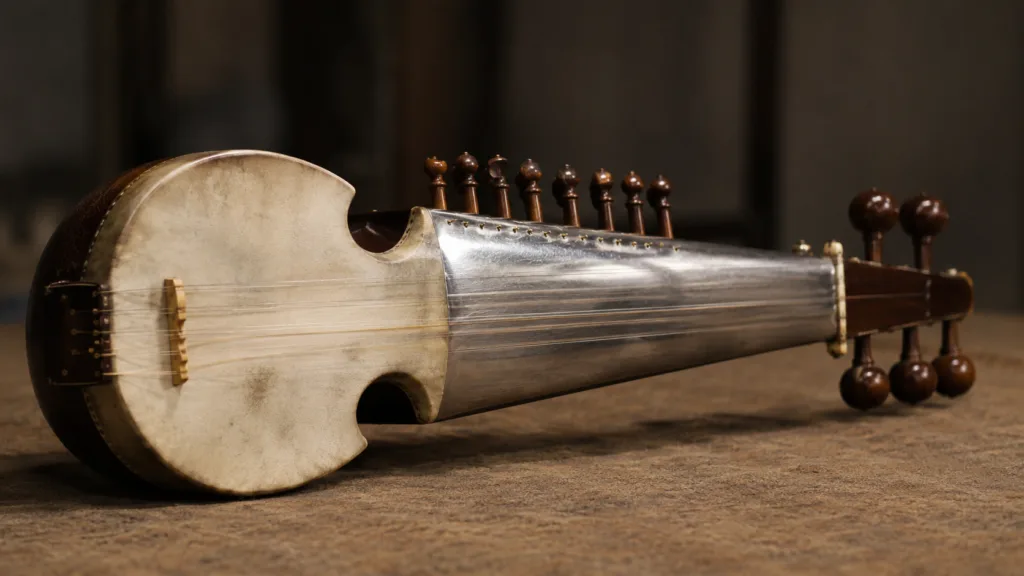
A sarod does not ask the player to press a string against wood. It asks for nail against metal, a clean stroke from a hard java plectrum, and a body that mixes carved wood with a taut skin soundboard. That is why its voice feels so direct: bright at the edge, deep in the center, and slightly smoky after the note leaves the string.
The instrument belongs to Hindustani classical music, yet it carries older lute ideas in its body. Its ancestry is often linked with the Afghan rabab, while its concert form grew through several North Indian lineages during the 19th and 20th centuries. The result is not simply a “fretless lute.” It is a carefully balanced machine for meend, resonance, fast right-hand work, and slow melodic unfolding.
Collector’s Note: Older sarods can differ sharply from today’s concert instruments. Some late 19th-century examples had no modern metal fingerboard yet, which changes both the look and the playing feel. For a collector, that single detail can say a lot about age, school, and repair history.
What Makes the Sarod Different?
| Feature | Common Material or Form | Effect on Sound and Playing |
|---|---|---|
| Fingerboard | Polished metal, often steel, chrome, or nickel-plated metal | Allows smooth slides and gives the sarod a clear, firm attack. |
| Soundboard | Taut goat skin over the lower resonator | Adds dryness, punch, and a drum-like response under the melody. |
| Body | Carved wood such as teak, tun, or similar hardwoods | Shapes warmth, projection, and the weight of the lower register. |
| Main Strings | Steel and bronze strings | Produce a strong, ringing tone with enough bite for fast passages. |
| Sympathetic Strings | Thin metal strings below the main playing strings | Respond quietly to the raga notes and create the sarod’s halo of resonance. |
| Plectrum | Java, often made from coconut shell | Controls attack, brightness, and the weight of each stroke. |
A sarod is usually described by parts, but the parts only make sense as a system. The metal fingerboard gives the left hand a glassy path. The skin-covered resonator gives the note its tight center. The tarab strings, or sympathetic strings, fill the space around the played note without turning the sound soft.
That mix is unusual.
On many lutes, wood softens the note after the string is plucked. On the sarod, metal and skin keep the sound alert. The note can bloom, yes, but it never loses its edge. A skilled player can make one phrase sound almost vocal, then strike the next line with the firmness of a small hammered bell.
The Name, the Lineage, and the Rabab Connection
The word sarod is often connected with ideas of melody or musical sound in Indo-Persian cultural settings, though exact word histories are not always neat. What matters for the instrument is the family resemblance: short-bodied lutes, skin tables, carved resonators, and plucked strings traveled across regions and slowly changed hands, materials, and playing needs.
The Afghan rabab is the usual reference point. It has a carved body and skin soundboard, and its older role as a plucked lute helps explain why the sarod feels both courtly and earthy. But the sarod did not remain a rabab with a new name. It became a different concert instrument.
The modern sarod moved toward metal strings, a fretless metal fingerboard, wider melodic range, more sympathetic resonance, and a playing technique built for long slides. In other words: the instrument was reshaped for the grammar of raga performance.
Pro Tip: When comparing a sarod with a rabab, do not focus only on body shape. Listen for the left-hand language. The sarod’s smooth meend and metal-board sustain tell the difference faster than the outline of the instrument.
Sarod Anatomy From a Maker’s Eye
The sarod looks compact, but its construction is full of small tensions. A luthier has to manage the pull of many strings, the stiffness of the fingerboard, the response of a thin skin table, and the bridge position. Get one part wrong and the instrument may still look correct. It will not breathe correctly.
The Carved Wooden Body
The body is often carved from a solid block of hardwood. Teak and tun are often mentioned in relation to sarod bodies, while museum examples also show other regional woods. The lower chamber forms the main resonator, and the neck area continues upward into the pegbox.
Wood choice matters, but not in a magical way. A denser, stable hardwood helps the body resist string tension and supports a focused tone. A lighter or more open-grained piece can feel a little quicker under the hand, though it may not give the same weight in the lower notes. Seasoning is just as important as species. Fresh or poorly dried wood can move, buzz, or lose its setup.
The Goat-Skin Soundboard
The lower resonator is covered with goat skin, tightly fitted and glued. This is one of the sarod’s most character-shaping parts. A wooden soundboard would give a different kind of sustain; the skin adds a sharper response and a dry, percussive underlayer.
That is why a sarod can sound both melodic and struck.
The skin reacts to humidity, age, and tension. In a dry room it may feel tighter and brighter. In damp air it can soften, darken, or lose some snap. Players who travel with the instrument know this well. A sarod is not a plastic-stable object; it changes with the room.
The Metal Fingerboard
The fretless metal fingerboard is where the sarod becomes itself. The left hand does not stop the string behind a fret. It presses the string directly against the metal surface, often with the fingernail or a nail-and-fingertip combination. This allows continuous slides, microtonal curves, and smooth movement between notes.
Metal also brightens the stopped note. The sound has less of the warm thud that can come from soft finger contact on wood. Instead, the sarod gives a clean, ringing contact point — hard string, hard surface, immediate response.
The Bridge and the Hidden Work of Resonance
The broad bridge, often made from bone or a similar hard material, carries the main strings and guides the smaller strings below. Its height, curve, and groove depth shape volume and clarity. A bridge cut too low can choke the sound. A bridge cut too high can make the instrument tiring and stiff.
Small changes here are not small at all.
The sympathetic strings pass through or under the main string path depending on the design. They are tuned to match the raga’s pitch material, so when the main string sounds, nearby pitches wake up quietly. This is the shimmering background many listeners notice, even when they cannot name it.
Strings, Tuning, and the Sarod’s Voice
Modern sarods often have somewhere around 17 to 25 strings, though exact layouts vary by school, maker, and player. A common setup may include main melody strings, drone or support strings, chikari rhythm strings, and a row of sympathetic strings. The numbers are not decoration; they shape the instrument’s entire behavior.
| String Group | Typical Role | Sound Character |
|---|---|---|
| Main Melody Strings | Carry the raga melody and most left-hand slides | Strong, direct, and expressive |
| Drone or Support Strings | Support the tonal center and raga mood | Grounded, steady, and warm |
| Chikari Strings | Used for rhythmic sparkle and pulse | Bright, ringing, and energetic |
| Sympathetic Strings | Resonate in response to played notes | Soft, silvery, and atmospheric |
The main strings are usually steel or bronze. Steel brings clarity and speed. Bronze can add a little thickness and color to the lower or middle range. The combination gives the sarod its muscular but flexible tone.
Then come the tarab strings. They do not carry the melody in the ordinary sense. They listen. When a pitch aligns with them, they answer from below the surface, like fine dust lifting in a beam of light — visible only when the angle is right.
Collector’s Note: A sarod with missing sympathetic strings may still play a melody, but it will not show its full color. For buying, restoration, or appraisal, always check the small pegs, tarab string path, and bridge holes. These parts reveal how carefully the instrument has been kept.
How the Sarod Is Played
The right hand uses a java, a stiff plectrum traditionally associated with coconut shell. Its thickness and curve can change the attack. A heavier java gives more bite and authority. A lighter touch can skim the string and produce a softer, more liquid note.
The left hand is the harder story. Because the sarod has no frets, intonation depends on the player’s ear and muscle memory. The string must meet the metal board in the right place, with enough pressure to speak cleanly but not so much that the phrase becomes stiff.
This is why the sarod can sound effortless only after a lot of hidden work.
Nail on Metal
Many players use the fingernail to stop the string. Some use a mix of nail and fingertip. This detail is not cosmetic; it shapes the whole tone. Nail contact gives a clean edge and lets the string slide over the polished board. The phrase can bend, dip, and stretch without the interruption of frets.
A wooden fingerboard would not respond the same way. It would absorb more contact and wear differently. The sarod’s metal surface keeps the note alive under pressure.
Meend and Gamak
Meend means a glide between notes, and on sarod it can be long, vocal, and exact. Gamak refers to forceful oscillation or ornament, often carrying more weight. The sarod handles both with a special kind of firmness: the slide does not blur into mush; it keeps a bright line inside the movement.
That line is the instrument’s signature.
Sarod Vs. Sitar
The sarod and sitar often share the same broad stage: Hindustani classical performance, raga development, tabla accompaniment, and long-form improvisation. Yet they do not speak in the same texture.
| Point of Comparison | Sarod | Sitar |
|---|---|---|
| Fingerboard | Fretless metal board | Raised movable frets |
| Main Tone | Deep, firm, bright-edged, and direct | More overtone-rich, buzzing, and sparkling |
| Slides | Continuous slides on a smooth surface | Slides made by pulling strings across frets |
| Soundboard | Skin-covered resonator | Usually a wooden table with gourd resonator design |
| Attack | Hard plectrum stroke with a compact punch | Wire plectrum tone with a more ringing buzz |
The sitar often spreads light through overtones. The sarod compresses the note first, then releases it. That makes the sarod especially strong in phrases where weight, slide, and clean articulation must sit together.
Neither instrument is “better.” They solve different musical problems.
Pro Tip: For first-time listeners, compare a slow alap on sarod with a slow alap on sitar. The sarod will usually feel more compact and vocal in its slides, while the sitar often surrounds the note with more buzzing brightness.
Sarod Vs. Rabab
The rabab helps explain the sarod’s ancestry, but the two instruments serve different musical needs today. A rabab often keeps a more rustic, plucked-lute identity, with a shorter sustain and a warmer, earthier skin-head sound. The sarod developed toward concert raga performance, more metal-string clarity, and a wider ornamental language.
Where They Feel Related
- Skin soundboard: both can use a skin-covered resonating area.
- Carved body logic: both relate to carved lute traditions.
- Plucked identity: both depend on the right-hand attack for tone shape.
Where the Sarod Moves Away
- Metal fingerboard: the sarod uses a smooth fretless surface for long slides.
- Sympathetic strings: the sarod’s resonance system is more developed for raga color.
- Concert range: modern sarods often support a broader melodic and dynamic palette.
The difference is easy to miss in a still image. In sound, it is harder to miss. The rabab tends to speak with a shorter, woody-skin accent. The sarod carries a more polished, stretched, and ringing voice.
Six-String and Eight-String Sarod Designs
Modern sarod designs are often grouped into two broad families: instruments with six main pegs and instruments with eight main pegs. That simple count points to deeper choices about range, support strings, playing style, and lineage.
| Design Family | Typical Traits | Playing Feel |
|---|---|---|
| Six-Peg Style | Often linked with a more compact setup and fewer support strings | Clearer string layout, direct right-hand access, leaner resonance |
| Eight-Peg Style | Often includes extra support or drone strings, depending on school | More layered resonance and a broader tonal bed for alap |
| Maihar-Related Larger Design | Often longer, with more strings and expanded resonance options | Suited to deep, slow development and a wider sound field |
A larger instrument can offer more resonance, but it may also demand more from the right hand. Extra strings bring color, yet they also add tuning work and setup sensitivity. A simpler layout can feel cleaner and more immediate, especially for fast, sharply articulated passages.
For a maker, every added string asks a question: does it add music, or only complexity?
Material Choices That Change the Tone
A sarod is not just “wood, metal, and skin.” Each material sits in a stress relationship with the others. The strings pull, the bridge transfers pressure, the skin responds, the wood holds shape, and the metal board gives the left hand a stable path.
Teak, Tun, and the Body’s Weight
Teak is valued for strength, stability, and resistance to movement. Tun, used in several North Indian string instruments, can offer a lively response when properly seasoned. Other hardwoods may appear in older regional examples. The best body wood is not simply the hardest piece; it is the piece that holds form while still allowing the resonator to speak.
Too dead, and the sarod feels closed. Too lively, and the tone can scatter.
Steel, Bronze, and the String Palette
Steel strings bring a fast, bright response. Bronze strings can add a slightly darker edge, especially in lower or thicker positions. The mix gives the instrument its layered bite: not thin, not overly sweet, and never sleepy.
Skin Tension and Seasonal Change
The goat-skin table is one of the reasons the sarod has such a personal response. It does not behave like a fixed wooden plate. In a humid climate, the skin can relax; in drier air, it tightens. This affects attack, sustain, and even the feel under the plectrum.
Collector’s Note: Fine cracks, loose skin edges, sunken bridge areas, or uneven tension around the soundboard can matter more than decorative wear. Cosmetic age may be charming; structural fatigue is a different matter.
The Sarod’s Timbre: Deep, Bright, and Slightly Dry
The sarod’s tone is often called deep, but that word alone misses the bite. A good sarod has a firm lower register, a singing middle, and a treble that can cut without becoming brittle. The skin head keeps the sound from becoming too glossy. The metal board keeps it from becoming too soft.
It has grain.
In slow playing, the sarod can feel almost vocal because the left hand can pull notes through tiny pitch curves. In faster playing, the java gives clean separation. This dual nature explains why the instrument works so well in both meditative alap and brisk jor or jhala-style passages.
Why the Sound Feels Weighty
- Low string tension and body depth help the bass notes carry mass.
- The skin table adds a compact strike to the note.
- The metal fingerboard keeps slides clean and ringing.
- Sympathetic strings add a soft afterglow around the main pitch.
The sarod does not need a long echo to sound full. Its fullness comes from density: the note starts with pressure, opens into resonance, and leaves a fine metallic trace behind.
Role in Hindustani Classical Music
In Hindustani performance, the sarod is commonly heard as a solo melodic instrument with tabla and tanpura support. The tanpura gives the drone. The tabla enters later with rhythmic cycles. The sarod carries the raga’s melodic identity, moving from slow exploration to more active rhythmic play.
The instrument suits raga because it can shape notes between fixed pitches. In this music, the journey into a note can matter as much as the note itself. A sarod can approach a pitch from below, lean into it, pull away, then return with a slightly different shade.
That is where its fretless design earns its keep.
Common Performance Flow
- Alap: slow, rhythm-free melodic development, often focused on tone and raga identity.
- Jor: a pulse begins, but tabla may still be absent.
- Jhala: faster, brighter playing with rhythmic sparkle.
- Gat: a fixed composition enters with tabla accompaniment.
- Improvisation: the player develops phrases within the raga and rhythmic cycle.
This structure can vary, but it gives the sarod room to show both patience and speed. A phrase may stretch like warm metal, then snap into clean rhythmic strokes. Not dramatic. Just controlled.
Historic Development and Noted Lineages
The sarod’s modern form took shape through many hands. The instrument became more prominent in North India during the 19th century, and later artists and makers adjusted body size, string layout, resonance, and playing technique. Names such as Ghulam Ali Khan, Niyamatullah Khan, Allauddin Khan, Ali Akbar Khan, Radhika Mohan Maitra, Buddhadev Dasgupta, and Amjad Ali Khan are often discussed in relation to sarod style and design.
Each lineage carried a view of what the instrument should do. Some favored a leaner design. Others expanded the string setup and resonance. Some players preferred a certain fingerboard metal or a particular right-hand clarity. These choices were musical, not just decorative.
Late 19th-Century Sarods
Museum examples from the late 1800s show that the sarod was still settling into its modern identity. Some older instruments used wire and gut, parchment or skin surfaces, and construction details that differ from later concert models. A late 19th-century sarod may look familiar at first glance, then reveal older thinking in the fingerboard, peg layout, or bridge.
That makes antique sarods especially interesting to study. They show transition, not a frozen recipe.
20th-Century Concert Refinement
By the 20th century, the sarod had become a major concert instrument. Larger designs, refined string systems, polished metal fingerboards, and more standardized teaching traditions helped shape the sound listeners know today. Still, standard does not mean identical. A sarod made for one school may not feel right in another player’s hands.
Pro Tip: When reading about sarod history, treat “the modern sarod” as a family of related designs, not one exact blueprint. Peg count, string count, bridge layout, and fingerboard finish can all vary.
Sarod Vs. Sursingar
The sursingar is another deep-voiced Hindustani lute linked with older dhrupad-influenced aesthetics and low-register playing. It is not as widely heard today as the sarod, but the comparison helps show what the sarod does so well.
| Feature | Sarod | Sursingar |
|---|---|---|
| General Voice | Compact, bright-edged, and agile | Lower, broader, and more meditative |
| Playing Role | Strong in both slow raga development and fast concert passages | Often linked with slower, deeper melodic exploration |
| Projection | Clear attack with strong note definition | Weightier tone, often less nimble |
| Modern Presence | Widely performed in Hindustani classical concerts | Less common and more specialist |
The sarod sits in a useful middle place: deep enough for grave alap, bright enough for clear fast work, and compact enough for the concert stage. That balance helped it remain active while some related instruments became more niche.
Buying or Studying an Antique Sarod
An antique sarod should be judged with care. Decoration can catch the eye, but structure tells the truer story. A repaired skin, replaced bridge, changed pegs, or altered fingerboard can affect both value and playability.
What to Check First
- Skin condition: look for lifting edges, sagging, cracks, or uneven tension.
- Fingerboard surface: check for dents, lifting metal, corrosion, or poor refitting.
- Bridge fit: confirm that the bridge stands cleanly and does not crush the skin.
- Peg stability: loose pegs make tuning difficult and may point to worn holes.
- String path: check whether main, chikari, drone, and tarab strings follow a clean route.
- Body seams and cracks: inspect the carved wood around the waist and pegbox.
Some repairs are normal on older instruments. The question is whether they respect the sarod’s original design logic. A beautiful-looking repair that changes bridge pressure or string angle can damage the voice.
Collector’s Note: Avoid judging an old sarod only by polish. Fresh shine can hide heavy intervention. A stable old finish, honest wear near the playing area, and clean structural work are often better signs than a newly bright surface.
Care, Climate, and Handling
A sarod needs calm handling. The skin soundboard, metal fingerboard, and many strings all react to environment. Sudden heat, strong sun, or damp storage can affect tuning and setup.
Basic Care Habits
- Keep it away from direct heat: skin and wood can move under harsh temperature changes.
- Wipe the metal fingerboard gently: sweat and dust can dull the playing surface.
- Check bridge position: small shifts can change tone and tuning response.
- Loosen carefully for long storage: do not remove all tension suddenly without proper guidance.
- Use a stable case: the pegbox and skin area need protection from knocks.
For playable instruments, a skilled repairer who understands Indian string instruments is worth seeking. A general guitar repair approach may not suit the sarod’s skin table, bridge geometry, or tarab string path.
The sarod rewards patience. It also punishes shortcuts.
Listening for the Sarod
New listeners can recognize the sarod by three traits: a fretless sliding line, a firm plucked attack, and a subtle sympathetic glow. The tone is not as buzzy as a sitar, not as short as many folk lutes, and not as soft-edged as a purely wooden fingerboard instrument.
A Simple Listening Path
- Start with a slow alap: hear how the note bends before settling.
- Listen to the attack: notice the java’s clean strike at the start of each note.
- Follow the after-sound: the tarab strings add a quiet shimmer after the main note.
- Compare with sitar: the sarod usually feels denser and less overtone-buzzy.
- Notice the lower register: the bass notes often carry a dark, rounded push.
Once the ear catches those traits, the sarod becomes easy to identify. Even in a busy ensemble, its tone has a polished steel center and a skin-warmed body around it.
FAQ
Is the Sarod Hard to Learn?
Yes, the sarod is demanding, mainly because it has no frets.
The player must place each note by ear and stop the string on a smooth metal fingerboard. The right-hand java stroke also takes control and patience. A beginner can start slowly, but clean tone and accurate slides need steady practice.
How Do I Know If a Sarod Is Well Made?
Look for stable construction, clean string paths, a healthy skin table, and an even metal fingerboard.
A good sarod should feel balanced, tune reliably, and respond clearly across the strings. The bridge should sit properly, the pegs should hold, and the sympathetic strings should ring without unwanted buzzing.
What Is the Difference Between a Sarod and a Sitar?
The sarod is fretless with a metal fingerboard, while the sitar has raised frets.
The sarod usually sounds deeper, more direct, and more compact in attack. The sitar often has a brighter buzzing resonance and a more overtone-rich surface. Both are major Hindustani instruments, but their touch and tone are quite different.
Why Does the Sarod Have Sympathetic Strings?
Sympathetic strings add resonance around the main melody.
These strings are tuned to pitches used in the raga. When related notes are played, they vibrate softly and create a shimmering background. This gives the sarod more depth without covering the main line.
Can an Antique Sarod Still Be Played?
Some antique sarods can be played, but condition matters more than age.
The skin soundboard, bridge, pegs, fingerboard, and string layout must be checked first. An old sarod may need specialist repair before safe playing. Some examples are better preserved as study or collection pieces.