
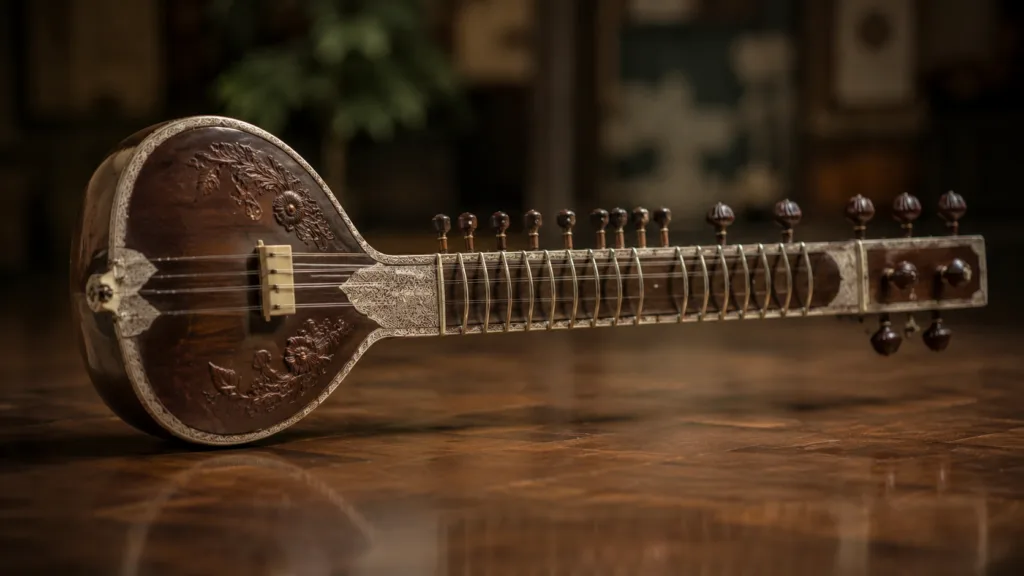
A sitar does not reveal itself all at once. The first pluck gives the note, but the instrument keeps answering after the finger has moved away. That lingering shimmer comes from sympathetic strings, a shaped jawari bridge, a hollow gourd body, and a long neck that lets the player bend a note far beyond the small motion seen by the eye.
Useful Starting Point: A modern sitar is usually a plucked, fretted lute of Hindustani classical music, with 6 or 7 main playing strings and often 11 to 13 sympathetic strings below the frets. The played note is only half the story. The other half is the instrument’s after-sound.
| Feature | Common Form | Why It Matters to Sound |
|---|---|---|
| Body | Dried gourd resonator, often called tumba | Adds a rounded, airy resonance without making the instrument too heavy |
| Neck | Long hollow wooden neck, or dandi | Carries frets, pegs, and under-strings while giving the tone a long chamber to bloom |
| Frets | Raised, curved, movable metal frets | Allow wide bends, raga-based adjustment, and vocal-style phrasing |
| Bridge | Broad, shaped jawari surface | Creates the bright, buzzing, overtone-rich edge people often associate with the sitar |
| Sympathetic Strings | Taraf strings below the frets | Vibrate in response to related notes and give the sound its halo |
The Shape of The Instrument and Why It Feels Alive
- The gourd body helps the note open with a dry but rounded warmth.
- The hollow neck carries extra resonance along the length of the instrument.
- The curved frets make wide string bends possible without choking the note.
- The jawari bridge shapes the buzzing edge rather than simply holding the strings up.
- The taraf strings react quietly below the main playing surface.
A sitar is often described as “long-necked,” but that plain phrase misses the way the instrument works under the hand. The neck is not just a handle. It is a resonant wooden chamber, a fret rail, a peg field, and a route for sympathetic strings that pass under the frets before reaching small tuning pegs along the side.
The main body, usually a dried gourd, gives the sitar its familiar rounded bowl. A well-prepared tumba feels light yet firm. Tap it gently and it should not sound dead, papery, or loose. The best gourds used for acoustic instruments are chosen for shape, wall strength, and the way they carry a low resonance without swallowing the treble.
Small details matter here.
A heavy decorative body may look impressive, but too much weight can make the instrument less responsive. A very thin body may speak fast but become fragile. The luthier’s task is not to make the sitar loud by force; it is to let the instrument answer with balance.
Collector’s Note: On an older sitar, the bowl should be checked for repaired cracks, uneven pressure marks near the tabli, and loose joints around the neck-body connection. A beautiful carving is not enough. The instrument must still hold tension cleanly.
Name, Roots, and The Sitar’s Changing Form
- “Sitar” is often linked to “setar,” a Persian term connected with a three-stringed lute.
- The modern sitar did not appear fully formed. Its parts, stringing, and musical role changed over time.
- Older sitars can differ strongly from modern concert instruments. Some historic examples had no sympathetic strings.
- Hindustani classical music shaped the instrument’s present identity. Raga performance, meend, drone strings, and jawari became central to its voice.
The sitar sits at a crossroads of long-necked lute traditions, courtly music culture, and North Indian performance practice. It is safer to see it as an instrument that was refined over generations rather than as a single object invented in one clean moment.
That matters because an antique sitar may not match the “standard” modern image. Some 19th-century examples have fewer strings. Some lack taraf strings. Some show a body outline or decorative taste that feels closer to an older workshop style than to the heavily ornamented concert sitars seen in the 20th century.
For a curator, those differences are not flaws. They are evidence.
The sitar’s later rise outside South Asia also changed how many listeners first met the instrument. Western audiences often heard it through recordings, collaborations, and stage performances, sometimes before they understood its role in raga-based music. Yet inside the instrument-making tradition, the deeper story remains more practical: wood, gourd, metal, bridge, tuning, and hand skill.
Main Parts of a Sitar
| Part | Also Called | What to Listen For |
|---|---|---|
| Large Resonator | Tumba | Roundness, air, and low-body response |
| Soundboard | Tabli | Attack clarity and how fast the note opens |
| Long Neck | Dandi | Sustain, balance, and support for frets and strings |
| Main Bridge | Bada Ghora / Jawari Area | Buzz, brightness, overtone spread, and note length |
| Small Bridge | Chota Ghora | Response of the sympathetic strings |
| Frets | Pardah | Clean intonation, bend room, and comfort under the hand |
| Wire Plectrum | Mizrab | Attack shape, snap, and rhythmic bite |
The sitar’s main melody string is often where a listener’s ear lands first, but the instrument’s design spreads the sound across many small contact points. A string touches a fret, pulls across it, meets the jawari bridge, and throws energy into the body. At the same time, the taraf strings below may begin to ring if they are tuned to matching or related tones.
That is why a good sitar can feel bigger than its visible motion. One finger pulls a string. Several parts reply.
Materials and Their Effect on Tone
- Seasoned wood helps the neck and soundboard stay stable under string tension.
- Gourd gives the resonator low weight and a dry, open body tone.
- Metal frets shape contact, sustain, and the feel of wide bends.
- Bridge material changes brightness, wear, and the speed of the attack.
- String metal affects tension, response, and the voice of each register.
The best sitar materials are not chosen only for beauty. They must hold shape, carry vibration, and survive tuning changes. A pretty piece of wood that twists under tension is a problem. A dull but stable piece may serve music better.
Tun Wood, Teak, and The Neck’s Hidden Job
Many sitars use seasoned tun or toon wood, while some makers also use teak. A neck wood needs enough stiffness to resist movement, but it cannot be so heavy that the instrument becomes slow or tiring. The neck is hollow, so the choice of wood affects more than structure. It helps decide how much of the string’s energy becomes ringing tone and how much disappears into mass.
Tun wood can give a responsive, lively body to the sound when dried and worked well. Teak can bring firmness and a certain grounded weight. In careless hands, either can fail. In good hands, both can speak.
Gourd Resonator Vs. Wooden Body
A dried gourd resonator tends to give the sitar an airy, rounded bloom. It does not behave exactly like a carved wooden bowl. The gourd’s curved wall and natural shell quality help produce a sound that is light but present, with a dry edge that suits the instrument’s buzzing bridge.
A wooden body, especially on some older or special builds, can feel more controlled and less gourd-like in its air response. It may offer focus, but it can also lose some of the open, breathing quality that many players expect from a concert sitar.
Pro Tip: When judging a sitar, do not listen only to volume. Listen to how the note opens, how it decays, and whether the sympathetic strings wake up cleanly. A loud sitar with a flat after-sound can feel tiring fast.
Bridge Material and The Jawari Surface
The bridge is not just a saddle. On a sitar, the jawari surface is shaped so the string makes a special kind of contact while it vibrates. This contact produces the familiar bright buzz and a spray of overtones. Too much contact can choke the note. Too little can make the sound thin or harsh.
Bridge materials vary by maker and period. Older instruments may show natural materials that were common in their time, while many modern bridges use ebony, synthetic materials, or other durable options. For a working instrument, the most important thing is not romance. It is whether the surface holds its shape and can be filed with control.
The bridge wears. Slowly, but it wears.
Once grooves become too deep, the sitar may lose clarity, develop uneven buzz, or refuse to sustain evenly across the main strings. A skilled jawari worker can reshape the bridge, but this is not a casual repair. It is close to voicing a piano hammer or cutting a violin bridge: small changes matter.
The Jawari Sound: Why The Sitar Rings and Buzzes
- The string is plucked with the mizrab.
- The vibrating string touches the wide bridge surface.
- The contact point shifts as the string moves.
- Extra overtones appear.
- The tuned sympathetic strings begin to answer.
Jawari is the shaped relationship between string, bridge, and soundboard. It is not a decoration, and it is not simply “buzz.” A bad buzz is loose, dirty, and uneven. A good jawari has order inside the brightness. The note still has a center.
Players often describe jawari as open or closed. An open jawari can sound brighter, more ringing, and more overtone-rich. A more closed setup can sound smoother and more focused. Neither is automatically better. The right choice depends on the player’s style, stringing, touch, and the instrument’s natural voice.
Here the luthier’s ear matters as much as the file.
| Jawari Feel | Likely Sound | Possible Tradeoff |
|---|---|---|
| More Open | Brighter, more buzzing, wide overtone spread | Can become rough if the bridge is not shaped well |
| More Closed | Cleaner, smoother, more controlled | May lose some shimmer and long after-ring |
| Uneven or Worn | Patchy buzz, weak sustain, dull or rattling notes | Usually needs skilled bridge work |
A sitar with good jawari does not merely sound louder. It sounds more awake. The main note has a clean start, then the edges flower into a controlled shimmer. On a fine instrument, even a slow phrase can keep the air moving.
Sympathetic Strings: The Hidden Choir Under The Frets
- They are not usually plucked directly during normal playing.
- They are tuned to notes used in the raga.
- They ring when the main strings excite matching tones.
- They make the sitar feel larger than its visible string count.
The taraf strings are easy to overlook because they sit below the main playing strings. They run through the neck and over their own small bridge. When tuned well, they create a fine halo around the melody. When poorly tuned, they can make the instrument feel cloudy or oddly lifeless.
They are patient strings. They wait for the right note, then bloom.
This is why tuning a sitar takes time. The main strings may be ready, but the sympathetic strings still need careful attention. A tiny change can make a phrase feel more resonant. Another small mistake can leave a raga’s main tones under-supported.
Listening Cue: After a single plucked note, listen for a soft second layer that rises behind it. That is not echo from the room. On a well-tuned sitar, the taraf strings are adding their own fine ring.
Frets, Meend, and The Vocal Pull of The Sitar
The sitar’s frets are high and curved. This gives the string room to move sideways when the left hand pulls it. That pull, called meend, lets the player travel between notes with a vocal curve rather than a stepped, guitar-like change.
A good meend is not a trick. It is grammar.
The raised frets also mean the player’s touch must be careful. Pressing too hard can sharpen the pitch. Pulling unevenly can disturb the phrase. On a finely set sitar, the string glides across the fret top with enough resistance to control the note but not so much that the hand fights the instrument.
Why Movable Frets Matter
Movable frets allow adjustment for different ragas and playing needs. They are tied to the neck rather than fixed into it like guitar frets. This makes the sitar more flexible, but it also demands care. A slightly shifted fret can make a phrase feel wrong even when the player’s hand is accurate.
For collectors, fret placement also tells a story. Old tied frets, replacement frets, and uneven fret wear can show whether an instrument was played, stored, repaired, or rebuilt. Not every mark is a problem. Some marks are honest use.
Kharaj Pancham Vs. Gandhar Pancham Sitar
| Feature | Kharaj Pancham Style | Gandhar Pancham Style |
|---|---|---|
| Common Association | Often linked with Ravi Shankar-style instruments | Often linked with Vilayat Khan-style instruments |
| Bass Range | Usually fuller, with low strings that support deeper phrases | Usually leaner, with a more singing upper-register focus |
| Upper Tumba | Often present on many examples | Often absent |
| Decoration | Can be ornate, with carved and inlaid surfaces | Often more restrained |
| Tone Character | Broad, ringing, bass-supported | Clear, vocal, agile, and direct |
Kharaj Pancham and Gandhar Pancham are not just collector labels. They point to different stringing ideas, playing approaches, and tone goals. A Kharaj Pancham sitar often gives the player a wider low range. It can feel grander in slow alap passages and stronger in bass-supported phrases.
A Gandhar Pancham sitar often favors a cleaner, more vocal line. Its identity is tied closely to gayaki ang, the singing style of instrumental playing, where bends and phrase shapes imitate the voice. It can sound less massive, but more immediate.
Neither style wins on paper. The better instrument is the one that serves the player’s phrasing.
Collector’s Note: A label such as “Ravi Shankar style” or “Vilayat Khan style” should not be treated as proof of quality by itself. Check the bridge, peg fit, fret work, neck straightness, gourd condition, and how the sympathetic strings respond after tuning.
Sitar Vs. Surbahar
- Sitar: brighter, faster response, more common in many concert and teaching settings.
- Surbahar: deeper, larger, slower to speak, often used for low-register, meditative development.
- Best listening difference: the sitar cuts and shimmers; the surbahar settles and rolls.
The surbahar is sometimes called a bass sitar, though that phrase can oversimplify it. It is larger, lower, and built for a broader, deeper register. Where the sitar can turn quickly, sparkle, and carry rhythmic drive, the surbahar often favors slow unfolding and weight.
For a listener, the difference is physical. The sitar feels like a bright line drawn across a resonant surface. The surbahar feels like that line has moved lower into the wood.
Sitar Vs. Sarod
| Point of Comparison | Sitar | Sarod |
|---|---|---|
| Frets | Raised movable frets | Fretless metal fingerboard |
| Main Texture | Buzzing, ringing, overtone-rich | Smooth, metallic, sliding, and deep |
| Playing Feel | String bends across frets | Slides on a smooth fingerboard |
| Resonance System | Gourd body and jawari-shaped bridge | Skin-covered resonator and sympathetic strings |
The sitar and sarod both belong to Hindustani music, and both can use sympathetic strings. Yet they feel quite different under the hand. The sitar uses frets as springboards for bent notes. The sarod uses a smooth fingerboard that lets the player slide directly along the string path.
So the sitar’s meend often has a pulled, elastic quality. The sarod’s slide can feel more continuous and glassy. Both can sing, but they sing through different bodies.
Acoustic Sitar Vs. Electric or Travel Sitar
- Acoustic concert sitar: fuller natural resonance, deeper interaction between body, bridge, and taraf strings.
- Travel sitar: easier to carry, often with reduced body size and a more compact feel.
- Electric sitar-style instrument: useful for amplified textures, but not the same acoustic system.
A smaller travel sitar can help a student or touring player, but it rarely gives the same body response as a full acoustic instrument. Less air space usually means less natural bloom. The note may still be clear, but the after-ring can feel smaller.
Electric sitar-style instruments are another matter. Some are closer to guitars fitted with special bridges or sympathetic-like design ideas. They can create a sitar-flavored texture in studio work, but they do not fully replace the acoustic conversation between gourd, jawari, frets, and taraf strings.
Useful? Yes. The same instrument? No.
How The Sitar Is Played
- The player usually sits on the floor with the resonator supported near the foot and leg.
- The right index finger wears the mizrab, a wire plectrum used to strike the string.
- The left hand presses and pulls strings across the raised frets.
- Drone strings add pulse and brightness, especially in rhythmic passages.
- The sympathetic strings react when the tuning and phrase line match their notes.
The right hand does not simply pluck. It speaks with strokes such as da and ra, and quick alternations can create a strong rhythmic bite. The left hand then shapes the note with pressure, pull, release, and timing. Together they make the sitar feel both percussive and vocal.
The instrument rewards patience. A beginner may first notice the buzzing sound. A careful listener soon hears the difference between a plain pluck, a controlled bend, a ringing drone, and a sympathetic response that arrives almost like a breath after the note.
Why The Sitar Does Not Tune Like a Guitar
A guitar is usually tuned to a fixed relationship between strings. A sitar is tuned around a tonic, raga needs, style, and the instrument’s own comfort zone. Many players choose a tonic near C-sharp or D, but this is not a universal rule. The best pitch is the one where the instrument opens without strain and the player can sing through it.
Because of this, tuning the taraf strings is part of musical preparation, not a side task. The raga asks for certain notes. The instrument answers better when those notes are waiting inside the neck.
Pro Tip: If a sitar sounds dull after the main strings are tuned, check the taraf strings before blaming the instrument. A few quiet strings below the frets can change the whole room.
Antique Sitar Details That Deserve Careful Inspection
- Gourd cracks: look for repairs, sunken areas, and weak seams.
- Tabli condition: check whether the soundboard has warped around the bridge.
- Neck line: sight down the dandi and check for twisting or uneven pull.
- Bridge grooves: deep string cuts may affect jawari and sustain.
- Peg fit: slipping pegs make tuning the main and sympathetic strings frustrating.
- Fret ties: loose frets can shift and disturb intonation.
- Decoration: older inlay materials should be documented and handled with care according to local rules.
An antique sitar should not be judged like a new factory object. A few worn spots may be part of its working life. But structural problems are different. A cracked gourd near the neck joint, a sinking bridge area, or a badly twisted neck can turn a charming object into a difficult repair.
Look under the strings too. Many people admire the front and forget the small taraf pegs, the lower bridge, and the tiny paths where sympathetic strings pass through the neck. Those quiet parts tell the truth.
Playable Antique Vs. Display Antique
A playable antique sitar must hold tuning, carry string tension, and respond evenly. A display antique may have historical or decorative interest even if it no longer works well as a concert instrument. Mixing these two categories leads to disappointment.
For collectors, the question should be simple: is the goal sound, history, or visual presence? A single instrument can offer all three, of course. Many do not.
| Use Case | What Matters Most | Main Risk |
|---|---|---|
| Concert Playing | Stable tuning, healthy jawari, good fret work, lively resonance | Buying an attractive instrument that cannot hold setup |
| Study and Practice | Comfort, reliable pegs, manageable string action | Choosing a hard-to-play instrument too early |
| Collection Display | Age, workshop traits, materials, surface condition, provenance | Assuming visual age means musical value |
Tone Colors a Trained Ear Notices
- Attack: how cleanly the note begins after the mizrab stroke.
- Core pitch: whether the main note stays clear inside the buzz.
- Jawari edge: how controlled or rough the overtone spread feels.
- Taraf response: whether the hidden strings bloom after matching notes.
- Decay: how long the note remains alive after the pluck.
- Balance: whether bass strings, melody strings, drones, and sympathetic strings support one another.
A fine sitar does not need to shout. It should let a soft phrase carry shape. In a quiet room, one well-played note can show the instrument’s condition: the mizrab gives the spark, the jawari spreads the edge, the body catches the tone, and the sympathetic strings release the afterglow.
Some instruments sound bright at first and empty after two seconds. Others do not impress immediately, then keep unfolding as the phrase develops. The second kind often rewards serious playing.
Listening Test: Pluck a main note, let it decay, then listen for the final third of the sound. If the end of the note still has color, the sitar is giving more than surface brightness.
Decoration, Craft, and What Ornament Does Not Tell You
Many sitars are visually striking. Carved leaves, floral patterns, celluloid-style inlay, dark borders, and polished surfaces can make an instrument look ceremonial before it makes a sound. This beauty belongs to the sitar’s workshop culture, but it should not distract from setup.
Ornament is not tone.
A plain Gandhar Pancham-style sitar may outplay a heavily decorated instrument if the bridge, fret work, pegs, and wood are better. On the other hand, an ornate concert sitar can be a fine musical instrument when decoration has not added clumsy weight or hidden poor joinery.
Small Workshop Signs
- Clean fret tying suggests careful setup habits.
- Even peg taper helps tuning stability.
- Bridge shaping shows the maker’s ear, not just hand skill.
- Balanced neck weight affects playing comfort.
- Neat taraf string paths reduce unwanted rattles.
These details are not glamorous, but they decide whether the sitar feels like a living instrument or a decorated object with strings attached.
Care, Storage, and Setup
- Keep humidity steady. Rapid changes can disturb wood, gourd, pegs, and glue joints.
- Support the body well. The gourd is strong in use but not meant for careless pressure.
- Do not over-tighten sympathetic strings. Small strings can break or stress tiny pegs.
- Use a proper case when moving the instrument. The bridge, pegs, and gourd need protection.
- Leave jawari work to a skilled repairer. Filing the bridge without experience can damage the voice quickly.
The sitar asks for calm handling. Not fear, just calm. Heat, dry rooms, sudden moisture, and careless storage can make tuning unstable and open small cracks. A musician may notice the change first as slipping pegs or a duller response. A collector may notice it later, when a repair has become harder.
For a working sitar, setup is ongoing. Strings age. Frets shift. Pegs polish themselves smooth. The jawari surface changes as strings cut into it. A serious player learns the instrument’s habits the way a violinist learns a bow or a guitarist learns an old acoustic top.
How to Choose a Sitar for Study or Collection
- Decide the purpose first: learning, performance, collection, or display.
- Choose the style: Kharaj Pancham for a broader bass setup, Gandhar Pancham for a leaner vocal focus.
- Check tuning stability: pegs should hold without forcing.
- Test jawari across strings: the buzz should feel controlled, not broken.
- Listen to the taraf response: sympathetic strings should wake up when tuned properly.
- Inspect the gourd and tabli: cracks and sinking around the bridge need attention.
- Ask who will maintain it: a sitar without access to proper setup can become frustrating.
A beginner often wants the most ornate sitar in the room. Understandable. The instrument is beautiful. But a student needs comfort, tuning stability, clear frets, and a forgiving setup more than heavy carving. A collector may accept fragile age if the historical interest is strong. A performer cannot.
There is no shame in choosing the practical one.
Pro Tip: Before buying, ask for a slow recording of single notes, bends, chikari strokes, and a short phrase after full tuning. Fast playing can hide weak sustain. Slow notes reveal the jawari.
Why The Sitar Still Holds The Ear
The sitar remains compelling because it combines precision with looseness in a very human way. The frets give places to land, but the left hand bends between them. The bridge gives brightness, but the gourd softens the body. The main string speaks directly, but the taraf strings answer from underneath.
It is structured, but not stiff.
That balance makes the sitar hard to reduce to one label. It is a melody instrument, a drone instrument, a rhythmic instrument, and a resonant object of craft. Its voice depends on the player, but also on the invisible patience inside the build: seasoned wood, a clean bridge curve, stable pegs, quiet joints, and strings that agree with each other.
Sitar FAQ
Is It Hard to Learn Sitar?
Answer
Sitar can be hard at first because the player must learn mizrab strokes, left-hand bends, tuning habits, and raga-based phrasing. A well-set beginner instrument makes the process much easier than a stiff or unstable sitar.
How Many Strings Does a Sitar Have?
Answer
Many modern sitars have 6 or 7 main playing strings and 11 to 13 sympathetic strings. The exact number depends on the style, maker, and setup.
What Makes The Sitar Sound So Bright and Buzzing?
Answer
The bright buzzing tone mainly comes from the shaped jawari bridge. As the string vibrates against the bridge surface, it creates extra overtones. The sympathetic strings then add a soft ringing layer behind the main note.
Is an Old Sitar Always Better Than a New One?
Answer
No. An old sitar may have historical charm, but it still needs a healthy gourd, stable neck, working pegs, good fret placement, and usable jawari. A newer well-made sitar can be better for regular playing.
What Is The Difference Between Ravi Shankar Style and Vilayat Khan Style Sitar?
Answer
Ravi Shankar-style sitars are often linked with the Kharaj Pancham setup, which usually has a fuller bass range and sometimes an upper tumba. Vilayat Khan-style sitars are often linked with the Gandhar Pancham setup, which usually has a leaner, more vocal sound and simpler decoration.