
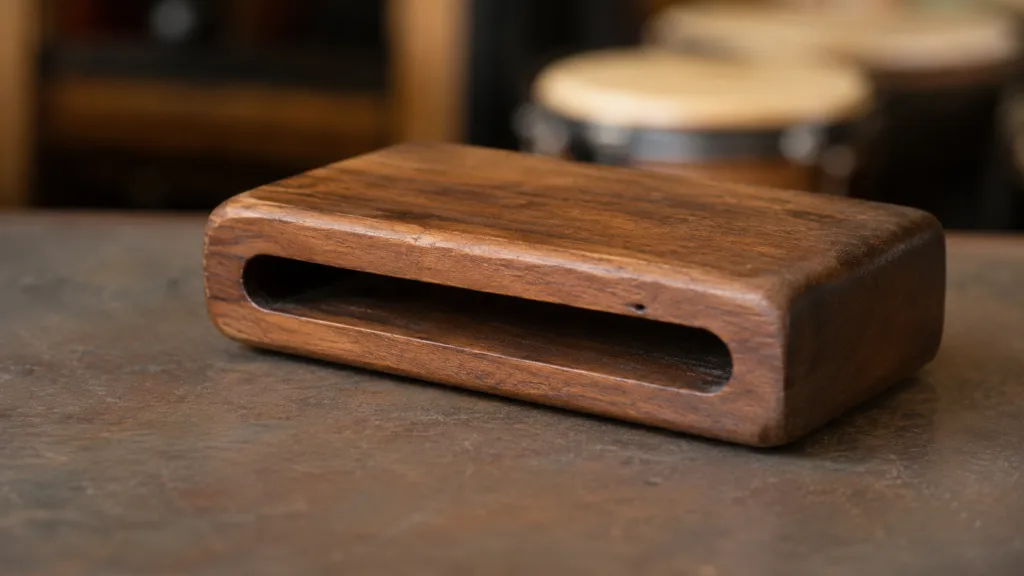
| Feature | What It Means For The Sound |
|---|---|
| Instrument Family | Struck idiophone; the body itself vibrates, with no string or drumhead. |
| Basic Form | A hollowed wooden block, usually with one or more slits that let the body speak. |
| Main Tone | Dry, short, bright, and sharply defined; more tok than ring. |
| Common Materials | Teak and other hardwoods; many teaching and concert models use maple, mahogany, oak, or similar dense woods. |
| Close Relatives | Temple blocks, slit drums, log drums, muyu, bangzi, claves, and plastic jam blocks. |
A woodblock can look almost too simple to matter: a cut piece of wood, a hollow inside, a slit, and a stick. Then it enters a score or a dance band and the whole room suddenly has a clean rhythmic edge. No shimmer. No long tail. Just a tight wooden snap that tells the ear, “listen here.”
That is the charm of the woodblock instrument. It does not hide behind sustain. It speaks fast, then gets out of the way.
What a Woodblock Actually Is
- It is a struck idiophone, meaning the solid body of the instrument makes the sound when hit.
- It is also a small slit drum, because its hollow chamber and slit shape the resonance.
- It is not a drum in the usual sense, since there is no stretched membrane.
- It is not a xylophone bar, because it is not mainly designed to play a tuned melodic line.
The usual orchestral woodblock is a single piece of hardwood with an interior cavity. The slit is not decoration. It lets the wooden body flex, breathe, and release a short burst of sound. Without that cut, the instrument would feel more like a dead knocking block.
Small thing. Big difference.
Pro Tip: A better woodblock is not always the loudest one. Listen for a clean attack, a clear center to the tone, and no loose buzzing after the strike. The best examples sound dry without sounding thin.
How The Shape Creates The Sound
The sound of a woodblock comes from three parts working together: the outside shell, the hollow chamber, and the slit. A player may strike only a small area, but the whole body answers. The result is a compact wooden crack with very little after-sound.
In a well-made block, the wall thickness is not random. Too thick, and the sound can feel stiff. Too thin, and the tone may lose authority or become fragile. The maker has to leave enough mass for projection while hollowing enough space for the body to open.
The slit works a little like a tiny doorway for resonance. It does not make the instrument ring like a bell; it gives the strike a short pocket of air to move through. That is why the woodblock feels both hard and hollow at once.
Why The Cavity Matters
- It lowers the perceived body of the tone compared with a solid block of the same size.
- It gives the attack a hollow center, especially on larger blocks.
- It helps the sound project without needing a long sustain.
- It creates slight pitch differences when different faces or block sizes are used.
A small, dense woodblock can cut through a busy texture with a bright click. A larger, deeper block can give more of a clock-like knock. Neither one is “better.” They do different jobs.
Wood, Grain, and Timbre
For a luthier or percussion maker, the wood is not just a material label. It decides how the instrument pushes back against the stick. A dense hardwood gives a firm attack. A more open-grained wood may soften the front edge a little. The finish, wall thickness, drying, and hollowing can change the result as much as the species name on the box.
Still, material matters. Quite a bit, actually.
| Material | Typical Feel Under The Stick | Tone Character |
|---|---|---|
| Teak | Firm and stable | Dry, clear, and controlled, often favored for orchestral-style blocks. |
| Maple | Hard, responsive | Bright attack with a tidy wooden body. |
| Oak | Strong and grainy | Bold attack, sometimes with a slightly rougher texture. |
| Mahogany | Warmer response | Rounder knock, less glassy than very hard pale woods. |
| Rubberwood and Similar Hardwoods | Even and practical | Clean projection for school, band, and general concert use. |
Two blocks made from the same wood can still sound different. The grain direction, internal cut, drying history, and strike area all leave a mark. On older instruments, even years of use can polish the striking face and slightly soften the first bite of the tone.
Collector’s Note: On an older woodblock, inspect the slit ends carefully. Tiny checks in the grain are common on aged wood, but a spreading crack that reaches the striking surface can change both tone and stability.
Woodblock Vs. Temple Block
Woodblocks and temple blocks are often placed near each other in percussion rooms, but they do not carry the same voice. A woodblock usually gives a sharper, flatter, more rectangular sound. A temple block often has a rounder, more hollow tone, especially in sets.
| Feature | Woodblock | Temple Block |
|---|---|---|
| Shape | Often rectangular or cylindrical | Often rounded, hollow, or set-based |
| Sound | Dry crack, short decay | Darker, more hollow knock |
| Use | Rhythmic marking, effects, orchestral color, Latin band patterns | Set patterns, color passages, pitched group effects |
| Pitch Sense | Usually one main pitch color | Often arranged in multiple relative pitches |
A temple block set can move in little pitch steps. A single orchestral woodblock is more like a punctuation mark. It does not sing a line; it stamps the rhythm into place.
Woodblock Vs. Plastic Jam Block
The plastic jam block is the road-tough cousin. It exists because wooden blocks can split, dent, or lose projection under heavy use. In drum kits, marching settings, and amplified music, plastic versions solve a practical problem: they are durable, consistent, and easy to mount.
But the ear knows the difference.
- Wooden woodblock: drier, grainier, more organic in attack, with small tonal differences from one instrument to another.
- Plastic jam block: louder, more uniform, more resistant to weather and hard playing.
- Best choice for concert color: often wood, because the tone blends naturally with acoustic percussion.
- Best choice for high-impact setup: often plastic, especially when durability matters more than subtle texture.
Pro Tip: If the part needs a crisp acoustic “clack,” choose wood first. If the part must survive heavy rim-style playing on a loud stage, a plastic jam block may be the safer working tool.
Woodblock Vs. Claves, Güiro, and Slit Drum
The woodblock sits in a wider family of wooden percussion, yet each relative has a different job. This is where many short descriptions blur the line. A wooden object is not automatically a woodblock in the musical sense.
| Instrument | How It Speaks | Main Difference From Woodblock |
|---|---|---|
| Claves | Two sticks struck together | No hollow block body; the player’s hand helps form the resonating space. |
| Güiro | Scraped ridged surface | Sound comes from scraping, not direct striking. |
| Large Slit Drum | Hollow log or carved body with one or more tongues | Usually larger, deeper, and more resonant. |
| Temple Block Set | Several hollow wooden blocks with relative pitch steps | More set-based and often rounder in tone. |
Think of the woodblock as the clean pencil mark of the wooden percussion family. It is not the longest sound, and it is not the warmest. It is the one that draws the line clearly.
The Older Family Behind The Instrument
The woodblock belongs to a broad family of hollow wooden instruments found in many musical cultures. Some are small enough to hold in one hand. Others are large enough to act like resonant wooden drums. What connects them is not a single origin story, but a shared acoustic idea: cut wood can be made to speak.
In East Asian traditions, rounded wooden instruments such as the muyu show how a hollow wooden body can support repeated rhythm and clear timing. The Chinese bangzi offers another related form, often brighter and more pointed. In Western concert settings, the woodblock became a compact auxiliary percussion voice, useful when a composer needed a dry strike that would not blur the texture.
In ragtime and early jazz language, the instrument has also been called a clog box or tap box. Those names make sense. The sound can suggest a hard shoe on a wooden floor, but in music it does more than imitate. It can push a groove, underline a comic moment, or give a passage a mechanical tick without needing a machine.
Notation Names You May See In Scores
- Woodblock or wood block in English-language parts.
- Bloc de bois or tambour de bois in French score markings.
- Holzblock or Holzblocktrommel in German markings.
- Cassa di legno in Italian markings.
- High woodblock and low woodblock when a part asks for pitch contrast.
These names can look more complicated than the instrument itself. They usually point to the same family of short, struck wooden sounds. When several blocks appear in one setup, players read the part by relative height: high block, medium block, low block.
Collector’s Note: Older score names can help date a performance practice, but they do not always identify an exact model. A “bloc de bois” marking may be played on a practical orchestral woodblock chosen for the room, ensemble, and part.
Playing Technique and Stick Choice
A woodblock rewards restraint. Hit it too hard and the sound can turn flat, ugly, or choked. Hit it with the right stick and the tone pops out cleanly, almost like a dry little spark.
Where To Strike
Most players strike the upper playing surface or a clearly responsive face, not the thin edge of the slit. The best spot is often found by ear. Move a few centimeters and the tone can change: one area may give a harder clack, another a slightly fuller knock.
Good players do this quietly before rehearsal starts. Tap, listen, adjust.
Which Beater Works Best
- Hard wood stick: sharpest attack, bright projection, very clear rhythm.
- Medium rubber mallet: rounder tone, less biting front edge.
- Soft mallet: usually too muted unless a special color is wanted.
- Drumstick shoulder: useful in kit setups, but it can dent softer blocks over time.
The beater decides how much of the wood’s surface bite reaches the listener. A hard stick shows every detail. A softer beater rounds the sound and can make a larger block feel deeper than it really is.
Mounting, Hand-Holding, and Resonance
A woodblock needs freedom to vibrate. If a clamp squeezes it too tightly, the tone can lose body. If the mount rattles, the instrument may produce a little metallic noise after every stroke. That small buzz can ruin the whole effect in a quiet passage.
Hand-held playing can sound natural, but the hand must not choke the chamber. Mounted playing gives steadier placement and works better when the percussionist has to move between instruments quickly.
- Keep the slit open and unobstructed.
- Avoid clamping across the most resonant part of the body.
- Check for stand noise before performance.
- Use a mount that holds firmly without crushing the wood.
Pro Tip: If a woodblock suddenly sounds dull, check the mount before blaming the instrument. A tight clamp, loose screw, or contact point against the stand can drain the sound fast.
How A Maker Thinks About A Woodblock
A fine woodblock instrument is not just drilled wood. The maker has to balance cut, mass, dryness, and feel. The outside must be strong enough to survive repeated strikes. The inside must be open enough to let the tone bloom for its very short life.
It is a tiny acoustic room carved into hardwood.
The Main Craft Decisions
- Wood Selection: The blank should be stable, well-seasoned, and free of weak cracks near the future slit.
- Grain Direction: Grain affects strength and the way impact travels through the body.
- Hollowing Depth: A deeper cavity can add body, but too much removal can weaken the shell.
- Slit Length: The slit controls flexibility and release; it must not invite splitting.
- Surface Finish: A smooth finish protects the wood, while too much coating may blunt the natural contact sound.
On some blocks, the craft is plain and workmanlike. On others, the edges are softened, the grain is matched, and the finish has the quiet care of a small cabinet piece. Either can sound good. The ear decides first; the eye follows.
How To Judge Tone Before Buying Or Collecting
A woodblock should be judged by sound before shine. A glossy finish can look handsome and still give a dull strike. A worn old block may look plain but carry a lovely, dry center.
| What To Check | Healthy Response | Possible Warning Sign |
|---|---|---|
| Attack | Clear and immediate | Blunt, papery, or uneven |
| Body | Short but not empty | Dead knock with no center |
| Decay | Fast and clean | Rattle, buzz, or loose after-sound |
| Strike Area | Several usable spots | Only one tiny spot works |
| Wood Condition | Stable grain and clean slit ends | Growing cracks or repaired breaks near the slit |
For antique or vintage examples, look at the strike marks. Light wear is normal. Deep dents, crushed corners, and widening cracks may show years of hard use. That does not always make the instrument unusable, but it should change how carefully it is played and stored.
Care, Storage, and Small Repairs
Wood reacts to rooms. Dry air can pull moisture from the grain. Damp storage can make finishes feel sticky or invite movement in the wood. A woodblock is tough in performance, but it is still a carved piece of timber with a stress point at the slit.
- Wipe dust with a dry, soft cloth.
- Keep it away from direct heat and damp storage areas.
- Do not soak the wood or use heavy household cleaners.
- Loosen harsh mounting pressure when storing the instrument.
- Check the slit ends every so often for new cracks.
Small surface marks are part of the instrument’s working life. Structural cracks are different. A crack that moves toward the cavity or across the strike face can change the tone and may need a careful repair by someone who understands wooden instruments, not just furniture glue.
Collector’s Note: Original finish, maker stamps, old mounting hardware, and period-appropriate wear can matter for a collectible piece. Heavy refinishing may make a block look cleaner while removing useful history.
Where The Woodblock Fits In Music
The woodblock is useful because it can be heard without taking up much sonic space. In an orchestra, it can mark a rhythmic figure. In a percussion ensemble, it can add a dry counter-line. In Latin dance settings, it can lock into a groove with cowbell, claves, and hand percussion. In theater music, it can suggest motion, timing, or a small comic edge without words.
It is direct. Almost stubbornly direct.
Common Musical Roles
- Rhythmic Punctuation: Short accents that cut through the ensemble.
- Clock Or Motion Effects: Repeated patterns that suggest ticking, steps, or steady movement.
- Dance Band Texture: A dry wooden layer against drums, bells, and shakers.
- Orchestral Color: A bright contrast beside softer percussion colors.
- Teaching Rhythm: A clear attack that helps students hear timing cleanly.
Because the note dies so fast, the woodblock exposes rhythm. Late strokes sound late. Uneven spacing shows. That makes it both forgiving in construction and unforgiving in performance — a funny little contradiction, but true.
Choosing The Right Woodblock Size
Size changes the voice. A small block gives higher, tighter attack. A larger block usually speaks lower and fuller. Sets are useful when a part needs contrast, but a single good block can cover many everyday needs.
| Use Case | Better Choice | Why It Helps |
|---|---|---|
| School Rhythm Work | Medium hardwood block | Clear sound, easy handling, not too piercing. |
| Orchestral Part | Concert woodblock with clean projection | Blends better with acoustic instruments. |
| Drum Kit Setup | Mounted block or jam block | Stable placement and strong durability. |
| Percussion Ensemble | Set of high and low blocks | Gives contrast without changing instrument family. |
| Collection Display With Playability | Stable vintage hardwood block | Offers age, material character, and usable tone. |
For a first instrument, a medium block is usually the most useful. Very small blocks can become too sharp for some rooms. Very large blocks may feel too dark if the part needs a pointed rhythmic click.
Small Details That Separate A Good Block From A Plain One
- The tone starts cleanly even at soft volume.
- The body feels balanced in the hand or on the mount.
- The slit is cleanly cut, with no ragged weak points at the ends.
- The striking surface is firm and not too soft or crushed.
- The finish protects the wood without sealing away the contact sound.
- The block has a clear voice from more than one reasonable playing spot.
A good woodblock does not need ornament. The best ones have a plain confidence: pick it up, strike it once, and the sound is already there.
FAQ
Is a woodblock hard to learn?
Answer
No. A beginner can make a clear sound right away, but steady timing, even strokes, and clean dynamic control take practice. The short sound leaves little room to hide uneven rhythm.
How do I know if a woodblock sounds good?
Answer
A good woodblock has a clear attack, a short but present body, and no unwanted rattle. It should not sound dead, papery, or loose after the strike.
What size woodblock should I choose first?
Answer
A medium woodblock is usually the safest first choice. It gives enough projection for ensemble use without becoming too sharp or too dark for general playing.
Is a wooden woodblock better than a plastic jam block?
Answer
Wood is often better for natural acoustic color, while plastic is often better for durability, loud stages, and heavy drum kit use. The better choice depends on the setting.
Can an old woodblock still be played?
Answer
Yes, if the wood is stable and the slit area is not badly cracked. Light wear is normal, but spreading cracks, loose mounts, or crushed striking surfaces should be checked before regular use.