
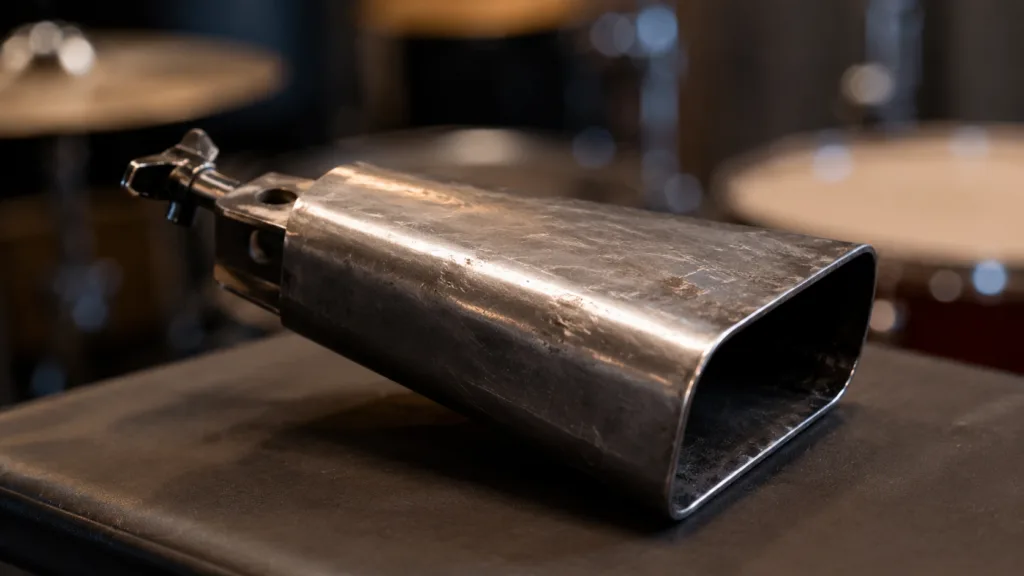
A cowbell looks almost too plain to deserve close study, yet a well-made one can tell a drummer more about metal, air, rhythm, and touch than many larger instruments. It has no skin to tune, no strings to stretch, and often no clapper inside. Still, when a stick meets the lip of the bell, the whole shell wakes up.
Useful Starting Point: In percussion terms, the modern musical cowbell is usually a struck metal idiophone. That means the body of the instrument itself vibrates. In Latin settings, many players also call it cencerro or campana, depending on the musical setting and local language.
| Feature | What It Means for The Player |
|---|---|
| Instrument family | Percussion; more precisely, a metal idiophone |
| Common build | Folded, shaped, and welded sheet metal with a rectangular or tapered mouth |
| Typical musical type | Clapperless cowbell struck with a wooden stick, dowel, or drumstick |
| Main sound character | Sharp attack, focused metal tone, short-to-medium sustain, strong projection |
| Common music settings | Afro-Cuban music, salsa, mambo, cha-cha-chá, Latin jazz, funk, rock, pop, go-go, orchestral color |
Small instrument, big responsibility. The cowbell often carries time where a drum would feel too heavy and a cymbal would feel too washy. Its tone is dry enough to mark the grid, bright enough to cut through brass and guitars, and simple enough to expose every uneven stroke.
What Makes a Cowbell a Musical Instrument?
- It is not just a farm bell moved onto a stage. A musical cowbell is shaped for projection, stick response, and repeatable tone.
- It does not need a tuned scale to be expressive. Players change color through strike zone, angle, pressure, and damping.
- It often works as a timeline instrument. In many groove-based settings, the bell helps the band feel where the beat sits.
A traditional animal bell often has an internal clapper. The animal moves, the clapper swings, and the bell rings. A modern percussion cowbell is usually clapperless. The player becomes the clapper, but with far more control: open strokes, muted strokes, edge hits, shoulder hits, and hand-damped notes all sit under the same stick.
That is why the instrument has such a direct feel. There is no soft head between the player and the sound. No felt hammer, no reed, no bow hair. Just wood against metal.
Luthier’s Bench Note:
A cowbell’s tone is not only about size. The mouth opening, wall thickness, weld stiffness, taper, finish, and mounting point all shape how the metal flexes. Two bells of similar length can feel very different under the stick.
The Body, Mouth, and Metal Tone
Most musical cowbells use a tapered metal shell with one open end, often called the mouth. The mouth is not a decorative detail. It is where much of the instrument’s tone blooms, and it gives the player a striking zone with several shades.
- Near the mouth: brighter, sharper, more forward.
- Higher on the body: drier, slightly darker, more controlled.
- With hand pressure: shorter sustain and a more compact click.
- With a loose grip: more ring and wider overtones.
The best cowbells do not only sound “loud.” They have a centered voice. The attack speaks fast, then the body gives a small metal bloom behind it. Poorly balanced bells can feel splashy, thin, or harsh, especially when a drummer plays steady eighth notes at higher volume.
Dryness matters.
In a dense salsa band or a loud rock mix, too much ring can smear the groove. A drier cowbell leaves space for congas, snare, hi-hat, piano montuno, guitar, bass, and horns. That little pocket of space is where the bell earns its keep.
Steel, Brass, and Coated Finishes
Many modern cowbells are made from steel because it gives strong projection, holds shape well, and can produce a crisp attack. Some bells use brass or brass-like alloys, especially in tuned or orchestral contexts. Brass can feel warmer and less biting, though the final sound still depends heavily on shape and wall thickness.
| Build Detail | Usual Sound Effect | Best Use |
|---|---|---|
| Thicker steel wall | Drier attack, more controlled ring | Rock, funk, loud stage setups |
| Thinner shell | More lively overtones and easier vibration | Hand percussion, lighter Latin textures |
| Wide mouth | Lower, broader voice with more body | Mambo bell, bongo bell, larger ensemble sound |
| Narrower mouth | Tighter, brighter, more pointed tone | Cha-cha bell, timbale accents |
| Painted or coated finish | Slightly softened ring, depending on coating | Studio work, controlled drum kit setups |
Pro Tip: When testing a cowbell, do not only hit it once in the store. Play a steady pattern for at least half a minute. A bell that sounds exciting on one hit can become tiring when repeated.
Cowbell History Without The Usual Shortcut
The name comes from bells used on cattle and other grazing animals, but the musical story is wider than that. Bells used for practical signaling, ritual sound, dance rhythm, and ensemble timekeeping appear in many cultures. The concert and dance-band cowbell sits at a meeting point between useful object and crafted instrument.
In Latin percussion, the story becomes more specific. The clapperless metal cowbell became linked with Afro-Cuban and Cuban-derived music, especially where bells help define repeated rhythmic cycles. In Spanish-speaking contexts, players may say cencerro or campana. Those words are not decoration; they point toward real playing roles.
- Cencerro: often used for cowbell in Cuban and Latin music language.
- Campana: literally “bell,” often used by players when discussing bell parts.
- Bongo bell: usually a larger hand-held bell played by the bongó player during stronger song sections.
- Mambo bell: often a larger mounted bell used in timbales and drum set contexts.
- Cha-cha bell: often smaller and brighter, useful for crisp dance patterns.
The cowbell’s move into dance-band percussion did not happen because the instrument was fancy. It happened because it worked. A bell can cut through a crowded ensemble without filling too much sonic space. It can mark time while letting drums, voices, and dancers breathe.
From Herd Bell to Stage Bell
Animal bells usually serve location and identification. Their job is to ring when the animal moves. A stage cowbell has a different job: it must respond to a planned stroke, at a planned volume, in a planned rhythm. That shift changes the whole object.
The clapper is removed. The shell is shaped for stick contact. The handle or mount becomes part of the acoustic decision. Even the weld matters, because a stiff seam can shorten the ring and focus the attack.
Collector’s Note:
Older cowbells can be charming, but age alone does not make one musically better. Check the seam, mouth shape, mounting hardware, and whether the metal has been bent out of alignment. A bell with a cracked weld may still look honest on a shelf, but it may lose focus under repeated playing.
Clapper vs Clapperless Cowbell
This is one of the easiest details to miss, and it changes nearly everything about the instrument.
| Type | How It Sounds | Where It Fits |
|---|---|---|
| Clapper cowbell | Looser ring, natural swing from the internal clapper, less stick control | Pastoral color, tuned bell sets, orchestral color, folk settings |
| Clapperless cowbell | Clean attack, direct response, controllable mute and accents | Salsa, mambo, Latin jazz, funk, rock, pop, drum kit playing |
A clapperless cowbell feels more like a player’s instrument because every note is chosen. The stick decides when the bell speaks. The hand decides how long it speaks. The mounting clamp decides how freely the body vibrates.
That last point is easy to overlook. Tight hardware can choke the bell. Loose hardware can rattle. A good mount holds the instrument firmly but does not turn the shell into a dead lump of metal.
How The Cowbell Speaks in Latin Music
In Afro-Cuban and Cuban-derived styles, the cowbell is rarely just an “extra sound.” It often helps shape the energy of a section. A bongó player may move from the smaller drums to a hand-held bell in a louder montuno section. A timbalero may use mounted bells to push the arrangement, answer horn lines, or hold time while the drums add fills.
Here, the bell can feel almost like a rail under a train. Not glamorous, maybe. Necessary, absolutely.
Bongo Bell and Mambo Bell Are Not The Same Job
- Bongo bell: usually hand-held, often lower and fuller, played by the bongó player when the music opens up.
- Mambo bell: usually mounted, often played by the timbalero or drum set player, with a cutting attack for ensemble drive.
- Cha-cha bell: smaller and brighter, useful for lighter, more pointed patterns.
The differences can look small on a product page, but they feel large in performance. A bongo bell needs enough body to hold a dance section without sounding brittle. A mambo bell must project through brass, piano, bass, congas, and singers. A cha-cha bell should speak lightly, with a tone that does not bully the groove.
Pro Tip: For Latin playing, choose the bell by role before choosing it by volume. A loud bell in the wrong register can make the groove feel top-heavy.
The Bell and The Clave Feel
Many cowbell patterns sit inside a larger rhythmic design shaped by clave. The player does not simply hit steady notes over the band. The bell must lock with bass tumbao, piano montuno, congas, timbales, bongó, and vocal phrasing. When the bell sits right, dancers feel it before they think about it.
Too early, and the groove feels nervous. Too late, and it drags. Too loud, and it turns into a metal argument.
The better player keeps the bell present but not bossy. That takes touch.
Technique: How Players Shape One Bell Into Many Colors
A cowbell gives more than one tone. The shape is fixed, but the hand is not. Good players use the mouth, shoulder, body, grip pressure, and stick angle like a small mixing desk.
- Open mouth stroke: strike near the rim or mouth for a bright, ringing sound.
- Body stroke: strike higher on the shell for a drier, more compact tone.
- Muted stroke: press the holding hand against the bell to shorten sustain.
- Accent stroke: use a slightly stronger stroke without changing tempo or stiffening the wrist.
- Ghosted touch: play lighter notes between accents to keep motion without crowding the groove.
The wrist should stay loose. A stiff arm makes the sound hard and the time uneven. A relaxed wrist lets the stick rebound just enough, while the fingers keep the beater from flying around.
Hand-Held Technique
When holding a cowbell, many players cup the closed end or grip the handle area while leaving the mouth free to vibrate. Small changes in hand pressure can alter the ring. This is where the instrument becomes tactile. The player feels the metal’s answer through the palm.
Hand-held playing suits bongo bell parts because the player can damp, angle, and shape the sound in real time. The bell sits close to the body, and the groove can breathe with small hand movements.
Mounted Technique
Mounted cowbells appear on timbales, drum kits, percussion racks, and hybrid setups. The bell may sit above the bass drum hoop, between timbales, or near cymbals and blocks. Placement matters because the player must reach it without twisting the wrist.
- Mount it close enough for relaxed strokes.
- Keep the mouth angle comfortable for both open and muted sounds.
- Avoid placing it where the stick hits the clamp instead of the bell.
- Check for hardware buzz before recording or performing.
Some drummers place the cowbell near the bass drum or above the hi-hat area for rock and funk patterns. Timbaleros often place bells above and between the drums, where bell patterns, rim sounds, and fills can connect smoothly.
Practice Room Note:
Record a simple cowbell pattern with a phone. Listen only for spacing between strokes. The cowbell exposes rushed notes more clearly than many drums because the attack is so clean.
Cowbell vs Woodblock, Agogô, Jam Block, and Handbell
Similar instruments can sit near the cowbell in a percussion setup, but they do not do the same work. Choosing one over another changes the groove’s edge, color, and cultural reference.
| Instrument | Main Tone | Best Musical Role |
|---|---|---|
| Cowbell | Metallic, cutting, dry-to-ringing | Timekeeping, accents, salsa/mambo/funk/rock drive |
| Woodblock | Woody, hollow, short | Dry patterns, theatre effects, orchestral color |
| Agogô | Two or more related metal pitches | Brazilian styles, interlocking bell lines, melodic rhythm |
| Jam block | Synthetic, loud, very consistent | Marching, outdoor performance, loud drum kit work |
| Handbell | Pitched, ringing, smoother decay | Melodic bell choir, orchestral color, tuned passages |
Cowbell vs Agogô
The agogô usually offers more than one pitch, often two bells joined together. That lets the player create melodic-rhythmic patterns with a clear high-low relationship. The cowbell, especially the clapperless Latin type, often works more as a single focused voice with subtle timbral changes rather than fixed pitch changes.
Use agogô when the pattern needs pitch conversation. Use cowbell when the groove needs a firm metal center.
Cowbell vs Woodblock
A woodblock gives a dry click with very little ring. It can be neat and tidy, almost like punctuation. A cowbell has a stronger bite and a more obvious metal color. In a band, that metal color can carry through the mix without extra volume.
Cowbell vs Electronic Sample
Electronic cowbell samples can be useful, especially in pop, hip-hop, dance music, and home production. They stay perfectly consistent. That is both their gift and their weakness.
A real cowbell shifts slightly with each stroke. The angle changes. The rebound changes. The room changes. In a sparse track, those tiny differences can make the rhythm feel handled by a person, not pasted onto a grid.
How Cowbell Works in Modern Music
Modern players use cowbell in two main ways: as a visible percussion voice in Latin-derived patterns, or as a small but sharp rhythmic color in drum kit music. It can sit in the foreground, but it often does better when it rides just behind the main groove.
- In salsa and Latin jazz: it helps define sections, drive montuno passages, and support dance feel.
- In funk: it adds a hard, narrow attack that can sit between hi-hat and snare.
- In rock: it can mark a riff, intro, chorus lift, or drum break without adding cymbal wash.
- In pop production: it can give a groove a handmade percussion edge.
- In orchestral color: clappered or tuned bell sounds can suggest distance, pastoral imagery, or special texture.
The cowbell cuts because its sound lives in a narrow, bright area. It does not need much low end. It does not need long sustain. In fact, too much sustain can be the problem.
Studio Tip: In recording, a cowbell may need less microphone level than expected. Its attack can jump out after compression. Place it in the mix, then listen quietly. If it still feels clear at low volume, it is probably loud enough.
Why Drummers Mount Cowbells on Drum Kits
A drum kit cowbell gives a drummer another attack color without changing the whole setup. It can replace the hi-hat for a section, double a guitar riff, outline a funk pattern, or add a dry accent above the snare.
On a kit, the cowbell should not fight the ride cymbal or hi-hat. It should have its own lane. A low, dry bell near the bass drum can feel earthy and solid. A bright bell near the toms can feel more like a phrase marker.
Why Producers Still Reach for Cowbell
Producers like the cowbell because it gives a track a clean rhythmic fingerprint. One note can make a loop feel more physical. The sound is short, readable, and easy for listeners to follow.
But the cowbell also has a comic shadow in popular culture. That is real. A producer or drummer should know when the sound serves the song and when it distracts from it. Taste first. Volume second.
Choosing a Cowbell by Sound, Not Just Size
Size gives clues, but it does not tell the full story. Larger bells often sound lower and fuller. Smaller bells often sound higher and sharper. Yet two bells of the same length can differ because of metal thickness, taper, seam placement, and finish.
For Latin Percussion
- Choose a bongo bell with enough body for hand-held patterns.
- Choose a mambo bell that projects clearly when mounted near timbales.
- Choose a cha-cha bell when the part needs a brighter, tighter voice.
- Avoid overly ringing bells if the ensemble already has many bright instruments.
For Drum Set
- Pick a bell that sits between snare crack and cymbal wash.
- Use a secure mount that does not rattle.
- Test the bell with the stick you actually use.
- For loud rock, a drier bell often records better than a wildly ringing one.
For Collecting and Display
Collectors often care about maker, age, finish, wear, and cultural setting. Musicians care about response. The best antique or vintage cowbell for a wall is not always the best one for a gig. That said, some older bells have a hand-shaped irregularity that gives them a pleasant, slightly uneven voice.
A little irregularity can be beautiful.
Collector’s Note:
On a used cowbell, look for mouth deformation, seam cracks, bent mounting brackets, and loose internal debris. Cosmetic wear is often harmless. Structural damage changes the sound.
Care, Storage, and Setup
Cowbells are tough, but they are not indestructible. A bent mouth can alter the tone. A damaged weld can create buzz. Rust can spread under chipped paint if the bell stays damp.
- Wipe the bell after playing if hands or stage air leave moisture on the metal.
- Do not overtighten the mount until the shell feels choked.
- Store it away from heavy hardware that can dent the mouth.
- Check screws and clamps before recording, because small rattles become large problems under a microphone.
- Use the right beater for the style; a thick stick can make a small bell bark too hard.
If a cowbell loses its clean attack, the problem is often not the bell itself. It may be the mount, the playing angle, or the surface being struck. Change one thing at a time. That saves money and frustration.
Mini FAQ
Is Cowbell Hard to Learn?
Read the answer
The first patterns are easy to start, but clean cowbell playing takes control. The instrument exposes uneven timing, harsh accents, and weak damping very quickly. A relaxed wrist and steady spacing matter more than force.
What Is The Difference Between a Cowbell and a Bongo Bell?
Read the answer
A bongo bell is a type of cowbell often played by the bongó player, especially in stronger sections of Cuban-derived dance music. It is usually hand-held and has a fuller, lower voice than many smaller mounted bells.
Should I Buy a Mounted or Hand-Held Cowbell?
Read the answer
Choose a mounted cowbell for drum kit, timbales, or rack setups. Choose a hand-held bell if you want more damping control, especially for bongo bell patterns. Some bells can do both, but each role feels different in the hand.
Why Does My Cowbell Sound Too Harsh?
Read the answer
It may be too bright for the music, struck too close to the mouth, hit too hard, or mounted in a way that creates extra ring. Try a softer touch, a different strike zone, slight hand damping, or a drier bell.
Can Cowbell Work in Modern Pop and Rock?
Read the answer
Yes. Cowbell can add a sharp rhythmic color to pop, rock, funk, and electronic production. It works best when it supports the groove instead of drawing attention away from the song.