
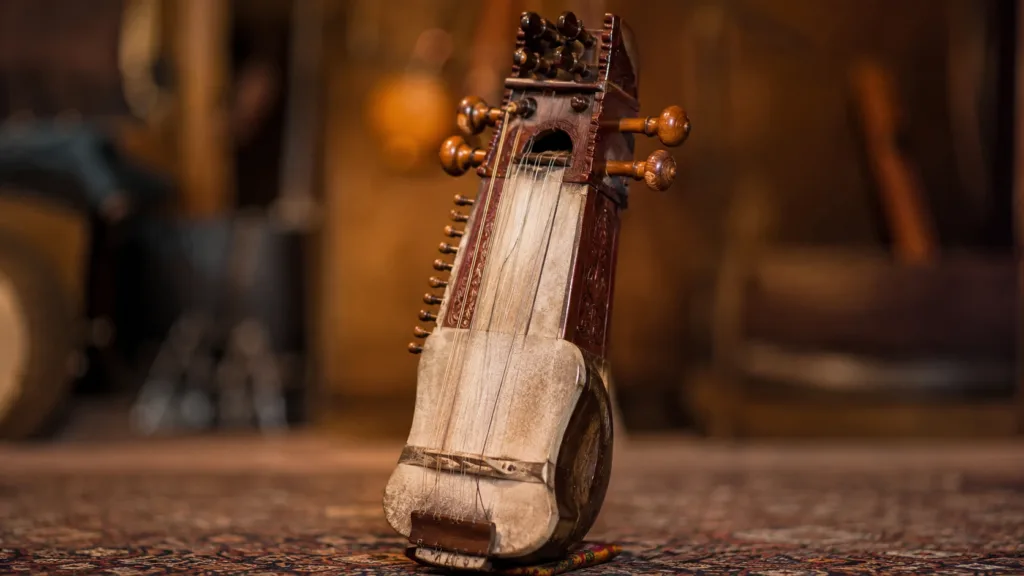
A sarangi does not ask the player to press a string down like a violin. It asks for the edge of the nail, a patient bow arm, and a body carved so cleanly that wood, hide, gut, and metal can answer one another without getting in the way.
This is why the instrument feels so different in the hands. The sarangi is a bowed, short-necked, fretless string instrument used across South Asia, with a special place in North Indian Hindustani music. Its voice is often described as close to singing, but that does not come from one magic feature. It comes from a set of physical choices: a skin-covered resonator, thick gut melody strings, a broad bridge, a carved wooden body, and a bed of sympathetic strings that wake up when the main notes are bowed.
Bench Note: A good sarangi is not merely “bright” or “warm.” It should have grain in the tone: a soft scrape at the bow, a full middle, and a faint shimmer from the tarab strings underneath. Too clean, and it can lose its speaking quality.
What Makes the Sarangi Different?
| Feature | Typical Form | Why It Matters to the Sound |
|---|---|---|
| Body | Usually carved from a single block of wood, often tun wood | Helps the instrument respond as one joined resonating shell |
| Soundboard | Skin-covered lower resonator | Adds a dry, vocal, slightly textured attack |
| Main Strings | Usually three thick gut strings; some examples include a fourth | Gives the bowed tone a rounded, human-like body |
| Sympathetic Strings | Often metal strings, with the number varying by instrument | Creates the halo of resonance below the played note |
| Finger Contact | Strings are stopped from the side with the nail or cuticle area | Allows long slides, curved intonation, and vocal ornament |
A sarangi is not fretted. There is no fingerboard map waiting to rescue the player. The left hand works in tiny, trained movements, and the pitch lives between muscle memory and ear. This is one reason the sarangi tone can bend so naturally into meend, gamak, and other vocal-style ornaments.
The instrument is usually held vertically, resting near the player’s lap. The bow moves across the gut strings while the left hand touches the string from the side rather than pressing it straight down. It sounds like a small detail. It is not.
The nail changes everything.
Body, Wood, and the Skin-Covered Resonator
The classical sarangi body is often described as being carved from a single block of tun wood. In instrument making, that matters because fewer joined seams can mean fewer places where energy gets lost. The body has a broad, compact shape, with a lower resonating chamber covered by skin rather than a thin wooden plate.
That skin is part of the sarangi’s identity. A violin top gives a smooth wooden bloom; a sarangi’s skin-covered belly gives a more immediate, reedy, slightly dry response. The result is not rough in a careless way. It has a tactile edge, like the first contact of a bow on a well-rosined string.
Collector’s Note: On older sarangis, inspect the skin table, bridge pressure area, pegbox, and lower end where string tension gathers. A fine old instrument may show honest wear, but open cracks, distorted geometry, or a sunken bridge area can change both tone and stability.
The bridge is another part worth studying closely. Many sarangis use a tall, shaped bridge that carries the main strings and routes the sympathetic strings. On some museum examples, the bridge is described as elephant-shaped. Beyond the visual charm, the bridge works like a traffic junction: thick bowed strings above, fine metal resonators below, all passing their vibration into skin and wood.
Why Tun Wood Is Often Favored
Tun wood gives the maker a useful balance: it can be carved cleanly, it is not as heavy as some dense hardwoods, and it can produce a responsive shell when the thickness is judged well. A sarangi body must be strong enough to handle tension, yet open enough to speak. Too thick and the tone can feel shut in. Too thin and the body may lose shape over time.
This is a luthier’s compromise, not a factory checklist.
Tun Wood vs. Heavier Hardwoods
| Material Choice | Likely Advantage | Possible Trade-Off |
|---|---|---|
| Tun wood | Good carving response, open resonance, traditional build character | Needs careful seasoning and thickness control |
| Heavier hardwood | Can feel stable and solid in the hand | May sound tighter if overbuilt |
| Over-thick carved body | May resist cracking better at first | Can reduce openness and low resonance |
| Over-light body | May respond quickly under the bow | May deform more easily under string tension |
The best sarangi makers do not chase wood hardness alone. They judge the blank, its grain, its dryness, the wall thickness, the bridge seat, and how the skin will behave once tension arrives. A little too much wood left in the wrong place, and the sarangi resonance becomes polite rather than alive.
Strings: Gut Above, Metal Below
The sarangi’s main playing strings are traditionally made from gut, often described in museum collections as goat gut. Gut has a slower, rounder response than many modern metal strings. It does not snap into speech with the same glassy edge. Instead, it gives the bow a little resistance, and that resistance helps create the instrument’s vocal weight.
Below the main strings sit the sympathetic strings, often called tarab. These are usually fine metal strings. The player does not bow them directly. They vibrate when their tuned pitch is excited by the note being played above them.
That hidden shimmer is the sarangi’s second voice.
Pro Tip: When judging a sarangi, do not listen only to the loudness of the three main strings. Play slow notes and wait for the after-ring. A responsive tarab system gives a soft, organized bloom, not a messy metallic buzz.
Main Strings vs. Sympathetic Strings
- Main gut strings carry the bowed melody and give the tone its thick, vocal center.
- Sympathetic metal strings add brightness, sustain, and a fine resonant mist around the note.
- The bridge connects both string systems to the skin-covered body.
- The tuning layout shapes how strongly certain notes and ragas glow under the hand.
Short descriptions often say the sarangi has “many strings,” but the better question is how those strings behave together. The main strings speak. The tarab strings remember.
Gut Strings vs. Metal Main Strings
A gut-strung sarangi gives the player more of the classic shaded tone: warm attack, complex middle, and a tactile bow response. Metal main strings, when used on some variants or modified instruments, can give more brightness and tuning stability, but they may also move the sound away from the older vocal character.
Neither choice should be judged in isolation. A bright body with bright strings can become sharp in the ear. A dark body with dull strings can become tired. The right match depends on the build, the player’s bow, and the musical setting.
The Sarangi Sound: Grain, Breath, and Bend
The sarangi is famous for its closeness to the human voice because it can shape pitch without frets. The player can slide into a note, lean away from it, press color into it, and let the sympathetic strings answer in the background. A plain note rarely stays plain for long.
Its timbre sits between a bowed lute, a skin-resonator instrument, and a singer’s curved line. The bow gives friction. The gut gives body. The skin gives a dry edge. The tarab strings give air.
It sounds carved, not polished.
Why It Can Feel So Vocal
- No frets allow continuous pitch movement.
- Nail contact lets the player glide along the string instead of clamping it down.
- Gut strings keep the core tone rounded and flexible.
- Sympathetic strings reinforce selected pitches and add a singing afterglow.
- Skin resonance gives the attack a living, slightly textured surface.
This is why a well-played sarangi can follow khayal, thumri, and other vocal forms with unusual closeness. It can carry a line that does not feel boxed into steps. Notes can bloom, bend, and settle.
A Listening Detail Many People Miss
Listen to the beginning and end of each note. On a plain bowed instrument, the pitch may seem to arrive and stop. On sarangi, a note often has a small front edge, a rounded center, and a tail of sympathetic response. That tail tells much about the instrument’s setup.
A weak tail may point to tired strings, poor sympathetic tuning, bridge trouble, or a body that is not opening well. A wild tail may mean the tarab strings are overactive or poorly balanced. The sweet spot is controlled shimmer.
Player’s Corner: Slow bowing exposes the truth. Fast phrases can hide a stiff body or uneven string response, but one held note will show whether the resonance system is healthy.
Playing Technique and the Nail-Stopped Note
Sarangi technique can surprise players who come from violin, cello, or guitar. The left hand does not press the string against a fingerboard in the usual way. Instead, the player stops the string from the side, often using the nail or the cuticle area. The finger touches, guides, and slides.
This makes pitch control demanding. It also gives the instrument its supple phrasing. With no fret and no hard fingertip pressure, the player can shape tiny pitch curves that would feel awkward on many other bowed instruments.
What the Left Hand Must Learn
- Finding pitch by ear rather than by fret position.
- Keeping the nail angle clean enough to avoid unwanted scraping.
- Sliding without losing tone pressure.
- Separating ornament from accidental pitch wobble.
- Balancing speed with clarity in fast passages.
There is a small brutality to the learning curve. Not harsh, just honest. The sarangi gives almost nothing away for free.
The Bow Arm Matters Just as Much
A heavy or uneven bow can make a sarangi sound nasal and cramped. A weak bow can fail to wake the gut strings. The player needs enough pressure to draw the string into vibration, but not so much that the tone chokes. On a good instrument, the bow feels as though it catches the string and then releases it into the body.
Pro Tip: New players often chase volume first. Better to chase even tone. A quiet note with a clean center teaches more than a loud note with a crushed edge.
Sarangi vs. Violin
| Point of Comparison | Sarangi | Violin |
|---|---|---|
| Playing Position | Usually held upright near the lap | Held under the chin or against the shoulder |
| String Contact | Stopped from the side with nail or cuticle area | Stopped by pressing fingertips onto the fingerboard |
| Resonator | Skin-covered resonating area | Wooden top and back plates |
| Extra Strings | Often many sympathetic strings | Usually four bowed strings, no tarab set |
| Sound Character | Vocal, grainy, resonant, flexible | Clear, projecting, smooth, direct |
The violin has a strong, focused line. The sarangi has a layered one. A violin note often feels like it comes from a clean wooden chamber; a sarangi note feels as though it has passed through wood, hide, gut, and a small cloud of tuned metal.
For Western string players, the hardest adjustment is not the bow. It is the left hand. The sarangi’s nail-stopped technique changes the way pitch is found, held, and released.
Sarangi vs. Esraj and Dilruba
The esraj and dilruba can look related to the sarangi at first glance because they are bowed South Asian string instruments with sympathetic strings. Yet their playing feel and construction logic differ. Esraj and dilruba usually have frets, while the classical sarangi is fretless. That one difference changes the whole personality of the instrument.
| Instrument | Frets | Main Feel | Best Known For |
|---|---|---|---|
| Sarangi | No | Demanding, vocal, highly flexible | Hindustani vocal-style phrasing and deep resonance |
| Esraj | Usually yes | Softer entry point for many bowed-string learners | Melodic lines with a lighter, sweeter bowing character |
| Dilruba | Usually yes | Stable pitch reference, broader body feel | Bowed devotional and classical-related repertoire |
For a beginner, the esraj or dilruba may feel more forgiving because frets offer visual and tactile guidance. The sarangi does not. It demands ear training early. In return, it gives a kind of pitch flexibility that fretted instruments cannot fully copy.
Which One Sounds Closest to a Singer?
The sarangi usually wins that question because it has no frets and uses side-stopped string contact. The note can be approached like a sung syllable, not just placed like a fixed pitch. Esraj and dilruba have their own beauty, but their frets create a different discipline.
Classical Sarangi vs. Folk and Regional Sarangis
There is no single sarangi shape that explains every regional instrument. Museum examples and living traditions show variation in size, number of strings, materials, and purpose. Some sarangis are built for classical Hindustani performance. Others belong more to regional or folk settings, with simpler stringing or a different body shape.
The name can travel farther than the exact design.
| Type | Common Build Direction | Sound and Use |
|---|---|---|
| Classical North Indian sarangi | Complex stringing, many sympathetic strings, gut main strings | Vocal-style Hindustani phrasing, accompaniment, solo performance |
| Smaller regional sarangi | May have fewer strings or different proportions | Often more direct, lighter, and tied to local song forms |
| Nepali sarangi | Often simpler, commonly four-stringed in folk use | Clearer folk-song function, portable and direct |
This matters for buyers and collectors. A small regional sarangi should not be judged as a failed classical instrument. It may have been built for a different job: song support, storytelling, local performance, or easier travel.
Collector’s Note: Before valuing a sarangi, identify the type and intended use. A regional instrument with fewer strings may be culturally important even if it does not match the full classical layout.
Older Handmade Sarangi vs. Modern Workshop Sarangi
An old handmade sarangi can carry a kind of settled response that new instruments need time to develop. The wood has already lived under tension. The bridge area has found its working shape. The player can often feel this under the bow: the tone starts with less argument.
But age alone is not proof of quality. Old cracks, twisted bodies, tired pegs, loose joints, hardened skin, and worn bridges can turn a charming object into a difficult musical tool.
When an Older Instrument Is Worth Serious Attention
- The body remains straight enough for stable bridge pressure.
- The skin surface is not badly sunken or torn.
- The pegs turn with firm, controlled resistance.
- The bridge sits cleanly and does not lean in a dangerous way.
- The sympathetic strings can be tuned without slipping or rattling.
- The main strings speak evenly across the bow.
When a Modern Instrument May Be the Better Choice
A well-made modern sarangi can be the safer option for students and active players. Fresh pegs, stable setup, clean string routing, and repairable construction matter. If the instrument will be used daily, reliability is not a small matter. It is the difference between practicing and constantly fixing.
The finest choice is not always the oldest one. The finest choice is the sarangi that can be tuned, played, maintained, and heard clearly.
How to Judge a Sarangi Before Buying or Restoring One
A sarangi can look ornate and still play poorly. It can look plain and speak beautifully. The safest inspection starts with structure, then moves to tone. Decorative carving should come later in the judgment.
| Area | What to Check | Why It Matters |
|---|---|---|
| Body | Cracks, twisting, repaired breaks, uneven wall movement | Body shape affects bridge pressure and resonance |
| Skin | Tears, sinking, loose edges, uneven tension | The skin carries much of the instrument’s attack |
| Bridge | Leaning, wear grooves, poor contact, wrong height | The bridge controls transfer from string to body |
| Pegs | Slipping, cracking, rough turning, poor fit | Stable tuning depends on peg health |
| Tarab System | Missing strings, buzzing, blocked holes, uneven response | Sympathetic strings shape the sarangi’s inner shimmer |
| Main Strings | Old gut, wrong gauge, uneven bow response | The main strings carry the playable voice |
For restoration, avoid rushing into replacement parts. A sarangi is a pressure system. Change one string gauge, bridge height, or skin tension, and the whole instrument can react. Work slowly. Listen after each change.
Pro Tip: If a sarangi buzzes, do not blame the sympathetic strings first. Check bridge contact, loose beads, peg fit, string grooves, skin tension, and any open wood seams. Buzzes travel; their source is often not where the ear first points.
Tuning and Setup Feel
Sarangi tuning is not one small task. The main strings need their working pitch, and the sympathetic strings need to match the musical material being played. In classical settings, the tarab strings may be tuned to support the raga, giving certain notes a stronger glow.
For a new player, this can feel like tuning a small room rather than tuning one instrument. Pegs must hold. Strings must settle. The bow must find the string. Then the instrument starts to answer.
Setup Signs That Something Is Wrong
- The main strings feel too high and fight the nail without tonal reward.
- The bow produces a thin tone even with clean pressure.
- Sympathetic strings rattle loudly instead of ringing softly.
- The bridge leans, shifts, or sits unevenly on the skin area.
- One main string dominates while the others sound closed.
A balanced sarangi does not need to be loud under the ear to be good. Projection and sweetness can be different things. Some instruments sound modest up close but carry a focused, fragrant line in a room.
Role in Hindustani Music
In Hindustani music, the sarangi has long been linked with vocal expression. It can support a singer, mirror sung ornaments, and also stand alone as a solo instrument. That solo role asks for rare control because the sarangi must present melody, mood, and movement without frets or fixed pitch supports.
Its strength is not speed alone. Many instruments can play fast. The sarangi’s gift is its ability to make a slow phrase feel alive from inside the note.
Why Vocal Accompaniment Suits It
A singer can stretch a syllable, rise slightly above pitch, settle back, and shape emotion through micro-movement. The sarangi can follow that kind of motion with unusual closeness. A harmonium, by contrast, gives fixed pitches. Useful, yes, but less flexible in curved intonation.
This is why the sarangi’s voice often feels less like a second melody and more like a shadow that understands the singer’s breath.
Care, Climate, and Everyday Handling
The sarangi combines organic materials: wood, hide, gut, hair, and often bone or similar hard bridge material on older-style builds. These materials react to humidity and heat. A dry room can tighten skin and stress gut strings. A damp room can soften response, disturb tuning, and invite unwanted movement.
Good care is simple, but it must be regular.
- Keep the instrument away from direct heat and strong sunlight.
- Loosen tension slightly if the sarangi will not be played for a long period.
- Use clean hands, especially around gut strings and skin.
- Check pegs gently; forced turning can crack old wood.
- Store the bow so the hair is not kept under full playing tension.
- Watch the bridge angle after string changes.
Collector’s Note: A display-only sarangi still needs respect. Skin, gut, and pegs can fail quietly over time. If the instrument is valuable, avoid hanging it in a hot, dry, or sunlit room just because it looks beautiful there.
What Kind of Player Is the Sarangi For?
The sarangi suits a patient player who enjoys pitch detail, slow listening, and tone shaping. It is not the easiest first bowed instrument. That said, difficulty should not scare away a serious learner. It only asks for the right expectations.
A guitarist may miss frets. A violinist may need to relearn the left-hand idea. A singer may understand the phrasing quickly but still need time with the bow. Different doors, same room.
A Sarangi May Be a Good Match If You Want:
- A bowed instrument with vocal-style slides and curved intonation.
- A tone that blends gut-string warmth with metallic sympathetic shimmer.
- An instrument tied to Hindustani melodic thinking.
- A challenging fretless technique that rewards careful listening.
- A collectible instrument where construction details matter as much as decoration.
It May Not Be the Best First Choice If You Need:
- Fast early progress with fixed pitch markers.
- A low-maintenance travel instrument.
- Easy tuning with only a few strings.
- A modern standardized build where every model feels alike.
The sarangi is generous, but not casual. It gives more to the player who returns to the same note again and again, listening for the small change after the bow settles.
Common Myths About the Sarangi
Myth: It Is Just an Indian Violin
It is bowed, yes, but the construction and playing method are very different. The skin resonator, nail-stopped technique, sympathetic string system, and upright playing position give the sarangi its own identity.
Myth: More Sympathetic Strings Always Mean a Better Instrument
More strings can add resonance, but only when the bridge, body, tuning, and setup can support them. Poorly managed tarab strings create noise, not depth.
Myth: Old Sarangis Are Always Better
Some older instruments are wonderful. Others are tired, cracked, or badly repaired. Age gives history; condition gives playability.
Myth: It Only Works as an Accompanying Instrument
The sarangi has a long link with vocal accompaniment, but skilled players also use it for solo performance. Its solo voice can be intimate, direct, and full of inner movement.
Mini FAQ
Is the sarangi hard to learn?
Answer
Yes, the sarangi is hard to learn because it is fretless and the player stops the strings with the nail or cuticle area rather than pressing with the fingertip. The bowing, tuning, and sympathetic string response also need careful control.
How do I know if a sarangi is well made?
Answer
A well-made sarangi should have a stable body, clean bridge contact, healthy skin tension, smooth pegs, even main-string response, and sympathetic strings that ring clearly without harsh buzzing.
What is the sarangi made of?
Answer
A classical sarangi is often carved from a single block of wood, commonly tun wood, with a skin-covered resonator, gut main strings, metal sympathetic strings, and a shaped bridge that transfers vibration into the body.
Does the sarangi sound like a violin?
Answer
The sarangi and violin are both bowed string instruments, but they sound and feel different. The sarangi has a skin-covered resonator, gut strings, sympathetic strings, and nail-stopped playing, which gives it a more vocal and textured tone.
Should a beginner choose sarangi, esraj, or dilruba?
Answer
A beginner who wants fixed pitch guidance may find esraj or dilruba easier because they usually have frets. A beginner who wants the sarangi’s vocal tone and is ready for slower ear-based learning may still choose sarangi.