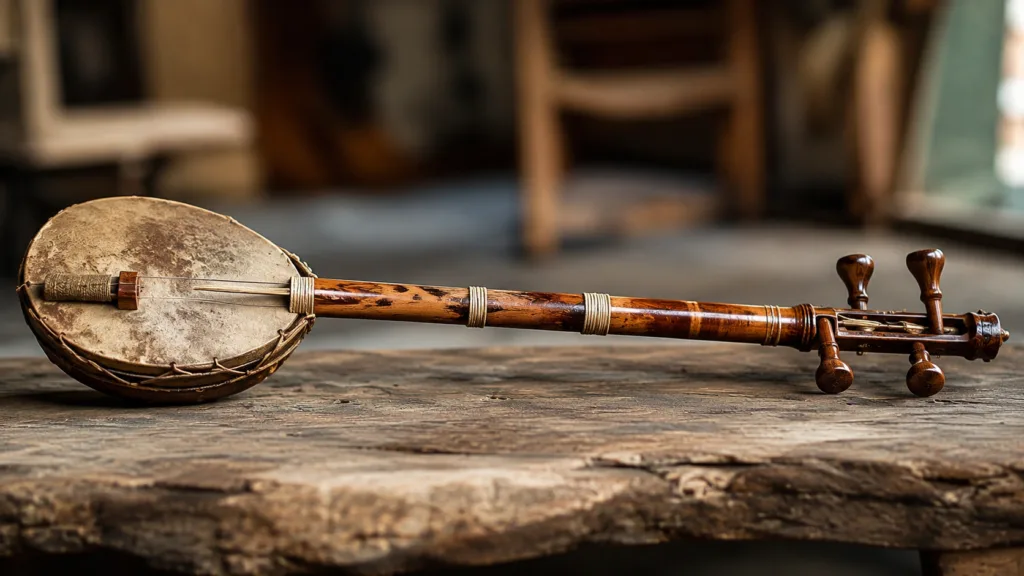
A rebab is not one fixed instrument. It is a family of bowed and sometimes plucked string instruments that moved through Arabic, North African, Persian, Anatolian, Central Asian, and Southeast Asian music cultures in several shapes. Some rebabs are narrow, upright spike fiddles. Some are boat-shaped North African lutes. Some later cousins, often spelled rubab or robab, are plucked rather than bowed.
That is why a good rebab description should not stop at “old bowed instrument.” The instrument’s real character sits in its skin-covered soundboard, light body, short sustain, close vocal tone, and the way a bow pulls sound from a surface that feels more like a small drumhead than a violin top.
Small body. Direct voice. No extra shine.
Main Rebab Forms and How They Differ
| Form | Common Region or Tradition | Typical Build | Sound Character |
|---|---|---|---|
| Spike Fiddle Rebab | Arabic, Egyptian, Anatolian, Indonesian, Malay traditions | Small body, long neck, skin or parchment face, played upright | Focused, nasal, speech-like, with a close and flexible tone |
| North African Rebab | Morocco, Algeria, Tunisia | Often boat-shaped, short-necked, usually bowed, sometimes with metal or wood covering the neck area | Dry, firm, rhythmic, suited to vocal accompaniment |
| Javanese or Sundanese Rebab | Indonesia, especially gamelan settings | Two-string bowed lute, often tuned to fit sléndro or pélog music systems | Ornamental, gliding, soft-edged, used to shape melodic flow |
| Malay Rebab | Kelantan and Terengganu traditions | Upright three-string instrument with a skin face and decorative headstock in many examples | Vocal, warm, slightly muted, often tied to storytelling and theatre traditions |
| Plucked Rubab or Robab Cousins | Afghanistan, Central Asia, parts of South Asia | Carved wooden body, skin-covered resonator area, multiple strings in many forms | Plucked, percussive, resonant, closer to a lute than a bowed fiddle |
This spread of forms explains why old catalogues can feel confusing. The same root name can point to a bowed spike fiddle, a North African bowed lute, or a plucked rubab-like instrument. The spelling also changes: rabab, rabāb, rebap, rubab, robab, rebeb. The family resemblance is real, but the instruments are not always interchangeable.
Collector’s Note: When an old label says rebab, inspect the body before assuming the type. A skin-faced spike fiddle, a North African boat-shaped fiddle, and a plucked Central Asian rubab may all appear under related names in older collections.
The Sound Starts with the Skin
The rebab’s voice comes from a simple but sensitive idea: a string presses through a bridge onto a thin membrane soundboard. That membrane may be hide, parchment, goat skin, buffalo intestine, or another prepared animal skin depending on the regional form. Unlike a violin, where a carved wooden top spreads and shapes the vibration, many rebabs send the string energy straight into a stretched skin surface.
The result is a tone with less long sustain and more immediate texture. Notes can sound close to the ear, slightly grainy, and almost spoken. A well-set rebab does not try to flood a room with polished volume. It leans into contour: slides, tiny pitch bends, ornaments, and phrases that sit near the human voice.
That skin is also the reason the instrument can feel alive under changing weather. Dry air tightens the surface and can make the sound brighter and more pinched. Humid air relaxes it and can make the tone softer, lower in response, or less stable. For a luthier, the membrane is not decoration. It is the throat of the instrument.
Why a Membrane Top Changes the Timbre
- Faster attack: the note speaks quickly because the bridge sits on a responsive skin surface.
- Shorter sustain: the tone often fades sooner than a violin note, which helps speech-like phrasing.
- Dryer resonance: the body gives color without the long wooden ring of many European bowed instruments.
- More touch sensitivity: bow pressure, humidity, bridge angle, and string tension can change the sound fast.
Here, a tiny adjustment can matter. Move the bridge by a few millimeters, change the string angle, or fit a slightly thicker skin, and the rebab stops speaking in the same way.
Anatomy of a Traditional Rebab
| Part | Common Material | What It Does | Effect on Sound |
|---|---|---|---|
| Body or Resonator | Wood, coconut shell, calabash, or carved hollow form | Holds the air chamber below the soundboard | Larger bodies often give a rounder low response; smaller bodies sound tighter and more direct |
| Soundboard | Hide, parchment, goat skin, buffalo intestine, or similar membrane | Receives vibration from the bridge | Creates the rebab’s dry, vocal, intimate timbre |
| Neck | Wood, sometimes with a metal or decorative facing | Supports string length and hand position | A fretless neck allows slides and flexible intonation |
| Bridge | Wood, bone, or carved hard material | Transfers string vibration to the skin | Bridge height and weight shape volume, response, and brightness |
| Strings | Gut, horsehair, silk, metal, brass, steel, or nylon depending on tradition | Produce the pitch under bow or pluck | Organic strings sound softer; metal strings add bite and projection |
| Bow | Wood with horsehair in many bowed forms | Pulls the string into motion | Loose bow tension can create a flexible, breathing attack |
Many rebabs have no fingerboard in the violin sense. The player stops or touches the string in a more direct way, often with delicate control rather than heavy pressure. This matters because the sound is not only made by the string; it is made by the meeting point between skin tension, bridge pressure, string material, and bow hand.
Pro Tip: A rebab with a beautiful body but a tired skin face may sound dull or unstable. On antique pieces, the membrane condition often matters more than decorative carving.
Rebab vs Rubab: Same Root, Different Hands
The words rebab and rubab often sit close together, but they do not always describe the same playing method. In many Arabic and Indonesian contexts, rebab points to a bowed instrument. In Afghan and Central Asian use, rubab often means a plucked lute with a carved body, skin-covered section, melody strings, drone strings, and sometimes sympathetic strings.
So the easiest practical split is this: a bowed rebab sings in a continuous line; a plucked rubab speaks in picked notes and ringing patterns.
| Feature | Bowed Rebab | Plucked Rubab or Robab Cousin |
|---|---|---|
| Playing Method | Played with a bow | Plucked with fingers or plectrum |
| Tone Shape | Continuous, vocal, sliding | Articulated, percussive, ringing |
| Body Feel | Often light, narrow, skin-faced, upright or held across the body | Often carved, lute-like, with a deeper resonator |
| Best Known Use | Vocal accompaniment, melodic ornament, ensemble color | Melody, drones, rhythmic plucked patterns |
The shared names tell a history of movement and adaptation. The hands tell the difference.
Rebab vs Violin: Membrane Warmth against Wooden Projection
The violin and rebab both belong to the larger story of bowed string instruments, but they answer different musical needs. A violin uses a carved wooden top, back, ribs, bass bar, soundpost, and a carefully arched body. It can project across a hall with bright upper harmonics and long sustain. The rebab, in many older forms, uses a smaller body and a skin or parchment face. It favors intimacy over shine.
On a violin, the bridge stands on a wooden top that distributes vibration into a complex box. On a rebab, the bridge often loads a membrane directly. That gives the note a more tactile edge. Not rough in a bad way — just less polished, more immediate.
- Violin: stronger projection, wider range, stable modern setup, long sustain.
- Rebab: closer voice, flexible intonation, shorter sustain, strong link to vocal phrasing.
- Violin bowing: often uses controlled hair tension and broad dynamic range.
- Rebab bowing: often rewards lighter pressure, curved ornaments, and careful contact.
Luthier’s Detail: A violin maker worries about arching, plate thickness, and soundpost fit. A rebab maker pays close attention to membrane quality, bridge load, body cavity, and how the string pressure wakes the skin without choking it.
North African Rebab vs Javanese Rebab
A North African rebab and a Javanese rebab may share a name, yet they sit in very different musical rooms. The North African form often works close to song. Its tone can be firm, narrow, and rhythmically useful, with the instrument supporting the human voice rather than showing off a wide solo range.
The Javanese rebab, especially in court gamelan settings, behaves more like a melodic guide. It can shape the flow of a piece through ornaments and long bowing lines. Its two strings are not there to create Western-style harmony. They help the player move through a tuning system and melodic language built around sléndro and pélog.
Same name, different job.
Why This Comparison Matters
Many short descriptions flatten the rebab into one “ancient fiddle.” That misses the craft. A North African boat-shaped rebab, a Javanese court rebab, and an Egyptian poet’s fiddle can differ in body shape, stringing, posture, and musical duty. For collectors and players, those differences are not small labels. They decide how the instrument should be held, tuned, restored, and heard.
Materials That Shape the Rebab’s Voice
Wood: The Quiet Frame Around the Sound
Wood gives the rebab its skeleton. In some forms, the body and neck are made from one piece of wood; in others, the resonator may be coconut shell, calabash, or a carved wooden bowl. Dense wood can give a firmer attack and clearer outline. Lighter wood can make the response quicker but less grounded.
The rebab is not always about heavy resonance. Often, the body’s job is to hold a small pocket of air and let the membrane soundboard do the speaking.
Skin and Parchment: The Living Surface
A skin face changes with age, tension, and climate. A thin, even membrane usually gives better response and cleaner articulation. A thicker or uneven skin may sound muted, but it can also give a pleasing old warmth when the setup is balanced. Too much tension can make the instrument sound tight. Too little tension can make it sag under the bridge and lose focus.
Old skin has a look that collectors learn to read: small wrinkles near the bridge, darkened contact points, repairs around the edge, and slight sinking where string pressure has lived for years.
Strings: Horsehair, Gut, Silk, Metal, and Steel
Rebab strings vary widely. Some older and regional forms use horsehair or gut-like materials. Others use silk, brass, steel, or modern substitutes. Organic strings usually give a softer, breathier note. Metal strings can add brightness, tuning stability, and a sharper edge under the bow.
That change is not just technical. A rebab with horsehair-style stringing can feel closer to speech. A metal-strung example may feel more cutting and easier to hear in a louder ensemble.
Pro Tip: Do not judge a rebab only by string count. One-string, two-string, three-string, and four-string examples can all belong to related traditions. Body type and playing method usually reveal more than the number of strings.
How the Rebab Is Played
In many bowed forms, the rebab is held upright, either resting on the lap, on the floor through a spike, or against the body depending on the regional style. Some North African forms may be held across the player’s body. The lack of frets allows smooth slides and flexible pitch work. This makes the instrument well suited to ornamented vocal lines.
The bowing is often lighter than a modern violin approach. Too much pressure can crush the sound, especially on a skin-faced body. The best tone usually comes from a careful balance: enough bow contact to wake the string, not so much that the membrane stops breathing.
- Posture sets the tone: the body must sit steady before the bow can speak cleanly.
- Bridge position matters: a leaning or misplaced bridge can weaken the response.
- Pitch is guided by ear: fretless playing needs close listening and small hand adjustments.
- Ornament is part of the voice: slides, turns, and small bends are not extra decoration; they are part of the language.
A plain note on a rebab can sound almost unfinished. Add a small slide into it, and the instrument suddenly makes sense.
Historical Path and Name
The rebab is often described as one of the early bowed instruments connected with medieval Arabic music. The word rabāb also became a broader name for several bowed string instruments over time. That is why it appears across many lands with different spellings and bodies.
Its history is not a straight line. It is more like a set of workshops, courts, storytellers, singers, and local makers solving the same question in different ways: how can a small string instrument carry a human-like line?
In Europe, related bowed instruments such as the rebec are often discussed in connection with the rebab name and early bowed-lute traditions. In Southeast Asia, the rebab became part of gamelan music, where it helps guide and decorate melody. In North Africa, it kept close ties with vocal performance. In Anatolian and Mevlevi contexts, rebab or rebap became linked with refined bowed-instrument traditions and older courtly sound colors.
Collector’s Note: A museum-style rebab from the late 19th or early 20th century may measure anywhere from roughly half a meter to nearly a meter depending on type. Size alone does not date it. Materials, construction method, wear, pegs, bridge, and regional body shape matter more.
Antique Rebab Details Worth Inspecting
An antique rebab can look simple at first glance, but it carries many small clues. The pegbox may show old tool marks. The skin may reveal past tension. The bridge may be original, replaced, missing, or reshaped. Decorative metal plates, carved heads, floral details, painted borders, shells, bone inlay, or pierced brass work can point toward a regional style or later repair history.
Look slowly. This instrument rewards slow looking.
Signs of Careful Old Craft
- Even membrane tension: the skin sits firm without deep collapse around the bridge area.
- Clean neck alignment: the string path runs naturally from peg to bridge to tail area.
- Stable pegs: old pegs may be worn, but they should fit the holes with sensible contact.
- Bridge footprint: marks on the skin can show where the bridge sat for many years.
- Honest wear: finger contact, bow marks, and edge darkening can support the object’s story.
Details That Need Caution
- Fresh thick varnish: it may hide cracks, repairs, or replaced surfaces.
- Over-tight modern strings: they can stress an old membrane or fragile neck.
- Missing bridge: the instrument cannot be judged fairly without correct bridge height and placement.
- Loose skin edges: even a small lift can drain volume and focus.
- Decorative repairs: attractive inlay does not always mean structural health.
For playable restoration, a rebab needs a maker who respects its light build. Treating it like a violin can cause trouble. The instrument asks for gentler judgment.
Why the Rebab Often Sounds Human
The rebab’s voice-like tone comes from several things working together. The fretless neck allows tiny pitch changes. The bow keeps the sound connected between notes. The membrane shortens the sustain and adds a grain that feels close to speech. The limited range in many forms also keeps the music near a singer’s register rather than pushing it into a wide concert-instrument span.
That narrowness is not a weakness when the music fits it. A small range can make the phrasing more concentrated. It asks the player to shape each note with intention.
Listen for the start of the note, not only the pitch. On a fine rebab, the beginning of the sound often carries the most character: a soft scrape, a quick bloom, then a dry tail that falls away without fuss.
Rebab in Ensemble Use
The rebab rarely acts like a loud solo instrument in the modern concert sense. In many traditions, it supports singing, leads a melodic turn, or shades the ensemble with bowed color. In Javanese gamelan, the rebab may help guide melodic direction and ornament the main line. In North African and Arabic settings, it often stays close to voice and text. In Malay traditions, it may support theatre, narrative, or ceremonial music forms.
This makes the rebab a musician’s instrument more than a showpiece. It listens while it plays.
Where Its Sound Fits Best
- Vocal accompaniment: the tone can blend with the singer rather than compete.
- Storytelling settings: short phrases and slides can follow spoken rhythm.
- Small ensembles: the instrument’s dry tone leaves room for percussion and voice.
- Modal music: fretless pitch gives the player room for subtle intervals.
- Gamelan texture: the rebab can decorate and guide melodic movement.
How to Hear a Rebab More Closely
When hearing a rebab for the first time, do not expect violin polish. Listen for grain, bend, breath, and contact. The bow may sound close to the string. The pitch may lean into notes rather than land on them sharply. The body may answer with a dry pulse instead of a broad wooden ring.
- Notice the attack: does the note start with a soft edge or a sharper bite?
- Follow the slide: many phrases gain feeling from the path between notes.
- Listen to decay: the short fade often reveals the membrane’s quality.
- Compare registers: the lower notes may sound earthy, while higher notes can become thin and piercing.
- Watch the bow hand: small pressure changes can alter the whole color.
A rebab does not always impress in the first second. Give it a few phrases. Then the voice appears.
Care, Storage, and Setup Notes
A rebab with a skin face needs more climate awareness than many solid-wood instruments. Sudden humidity shifts can change the membrane tension. Heat can dry old hide. Too much string tension can distort the bridge area. For antique examples, the safest approach is usually conservative: stabilize first, play later.
Basic Care Points
- Keep the instrument away from direct heat, strong sunlight, and damp storage.
- Do not force stuck pegs; old pegboxes can split.
- Loosen strings slightly if the instrument will not be played for a long time.
- Check the skin before bringing the instrument to pitch.
- Use a specialist for bridge replacement, membrane repair, or playable restoration.
Pro Tip: If an old rebab has been silent for decades, do not tune it straight to full playing tension. Let a repairer inspect the skin, bridge area, neck angle, and peg fit first.
What Makes the Rebab Worth Studying
The rebab sits at a rare meeting point: instrument making, oral tradition, regional craft, and early bowed-string history. Its shape can be plain. Its voice can be narrow. Yet those limits are exactly where its character lives. The instrument turns small gestures into sound: a bow pull, a slight finger lean, a membrane trembling under a bridge.
In antique collections, the rebab also teaches a useful lesson. Not every valuable instrument is loud, symmetrical, or standardized. Some instruments matter because they preserve a way of shaping tone that later designs moved away from.
Quiet craft, but not small craft.
Frequently Asked Questions
Is the rebab hard to learn?
Short answer
The rebab can be challenging because many forms are fretless and respond strongly to bow pressure. A beginner must train the ear for pitch, learn light bow control, and understand how the skin-covered body reacts to touch.
Is a rebab the same as a rubab?
Short answer
No. The names are related, but they can describe different instruments. Rebab often refers to bowed instruments, while rubab or robab often refers to plucked lute-like instruments in Afghan and Central Asian traditions.
How many strings does a rebab have?
Short answer
There is no single string count. Depending on the region and type, a rebab may have one, two, three, or sometimes four main strings. Some related plucked rubab forms may also have drone or sympathetic strings.
Why does the rebab sound different from a violin?
Short answer
Many rebabs use a skin or parchment soundboard instead of a carved wooden top. This gives the tone a shorter sustain, a more direct attack, and a closer vocal color compared with the stronger projection of a violin.
What should I check before buying an antique rebab?
Short answer
Check the skin face, bridge area, neck alignment, pegs, cracks, old repairs, and string tension. A beautiful antique rebab may still need careful restoration before it can be played safely.