
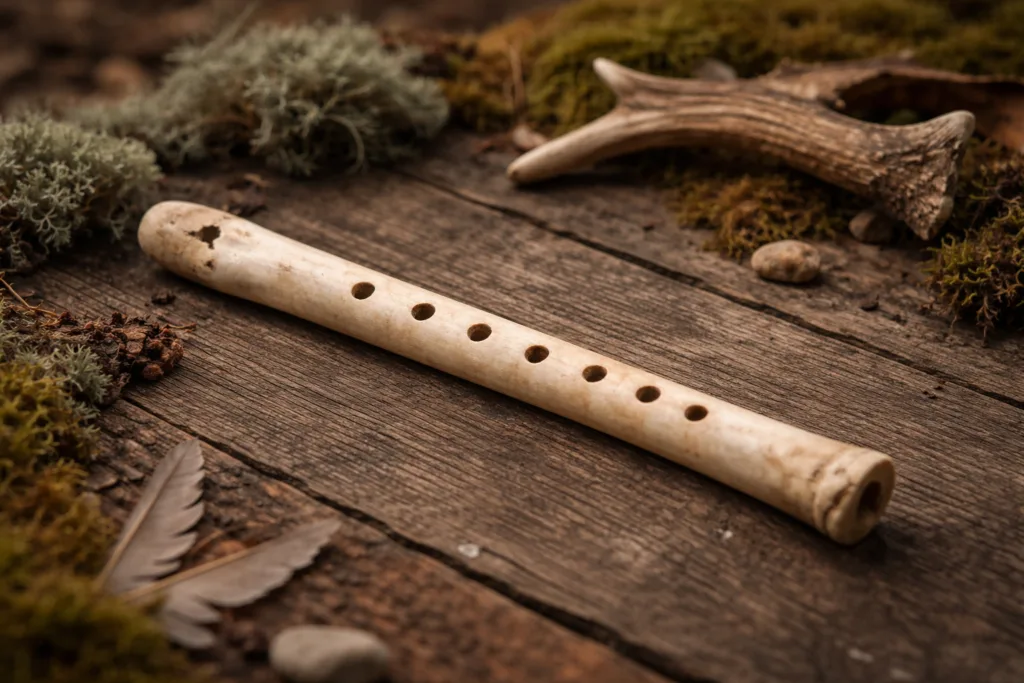
- Learn what a bone flute really is (and what it is not).
- Understand timbre, breath resistance, and how bone geometry shapes sound.
- Compare the instrument through focused “Vs.” sections, like a curator who also builds and sets up instruments.
- Get practical guidance for playing, caring, and choosing a modern replica without guesswork.
A bone flute is not just “a flute made from bone.” In the hand, it feels like a piece of anatomy turned into an aerophone: light but stubborn, smooth where it was worked, faintly grippy where the pores still speak. And when it sounds, its timbre can be startlingly direct—clean edge-tone with a soft veil of breath, like air meeting an ancient surface.
A Curator’s Snapshot Of The Instrument
| What You’re Holding | What It Usually Means For Sound |
|---|---|
| Naturally hollow bone (often bird wing bone in many archaeological examples) | Low mass, fast response, airy edge if the bore surface is left slightly textured |
| Finger holes (commonly a small set; some famous Upper Paleolithic examples show five) | Simple, direct pitch steps; cross-fingerings can add color but demand steady breath resistance |
| Notched or edge-blown mouth end (a carved notch can focus the airstream) | Sensitive embouchure angle; a small change in air direction can shift timbre |
| Short-to-medium tube length (varies widely by tradition and find) | Often sits comfortably in the hands; the sound can feel “close” and intimate rather than orchestral |
- Instrument family: edge-tone flute (an aerophone driven by a split airstream)
- Main variables: bore diameter, wall thickness, mouth geometry, hole spacing
- Player experience: responsive but honest—your air control is always audible on a bone flute
In museum terms, “bone flute” can cover everything from a tiny bird-bone aerophone meant to produce piercing calls, to longer notched flutes with multiple finger holes. As a maker, I group them by how they voice: if the mouth end helps you “aim” air at an edge, you get a tone that can be both pure and breath-laced—an ancient timbre that modern metal flutes rarely deliver without deliberate airy technique.
Bone does not forgive sloppy air.
What Makes A Bone Flute A Flute
- Air splits on an edge: the sound starts where your airstream meets a sharp lip or notch.
- Pitch comes from an open air column: the tube length and open holes define the vibrating length.
- No reeds required: unlike reedpipes, the bone flute speaks from edge-tone physics.
- Finger holes are valves: open holes shorten the air column; closed holes lengthen it.
The word “flute” is often used casually, but organologically it points to an edge-tone instrument: you push air, the air splits, and the tube amplifies that vibration into pitch. A bone flute is especially revealing here because its geometry is often simpler than modern keyed instruments. That simplicity is not “primitive.” It is focused. Every millimeter of mouth notch and every subtle rounding of hole edges changes how the instrument accepts air, how it stabilizes pitch, and how its timbre blooms.
Pro Tip 🎶
If a bone flute feels “silent,” don’t blow harder first. Change the air angle by a few degrees and narrow the airstream. Bone flutes often reward precision before they reward power.
How The Sound Is Born In The Hands
- Air preparation: a steady stream, usually narrower than you expect.
- Edge engagement: the stream strikes the notch/lip and splits.
- Feedback loop: the tube’s air column reinforces certain frequencies.
- Stability: your breath resistance and angle lock the tone in place.
- Color: micro-changes in air speed shift timbre from breathy to clear.
A well-voiced bone flute has a very particular “start.” The attack can feel almost like striking a match—soft friction, then ignition. If the bore is slightly textured, you may hear a whisper riding under the pitch. That isn’t a flaw; it is part of the instrument’s sonic fingerprint. In a quiet room, that breath-layer makes the timbre feel close to the ear, intimate, human.
The resistance is often more direct than on a modern concert flute. Many bone flutes do not “buffer” you with complex headjoint geometry; they tell you immediately if your air stream is wide, unfocused, or unstable. When you find the sweet spot, the tone can suddenly straighten—less hiss, more core—and the instrument feels like it is pulling the note out of you rather than letting you push it in.
The best bone flutes feel alive at low volume.
Material And Geometry: Why Bone Feels Different
| Build Choice | What You Hear | What You Feel |
|---|---|---|
| Thin-walled bird bone tube | Fast speaking, bright edge, airy halo in the timbre | Low inertia; small changes in air make big changes in response |
| Thicker mammal bone tube | A slightly denser core, often a steadier note center on a bone flute | More “push back” under breath; can feel stable but less quick to sparkle |
| Very smooth bore finish | Cleaner attack, less breath noise, a more “polished” timbre | Predictable response; less forgiving of weak edge geometry |
| Slightly textured bore finish | More breath character, sometimes a “reed-like” whisper without a reed | Feels lively; requires consistent breath resistance to avoid pitch wobble |
- Wall thickness affects how the tube damps vibration and how sharply it reflects air-column energy.
- Mouth geometry decides whether the flute speaks easily or demands a “key” of air angle.
- Hole edge shaping (rounding vs crisp edges) influences intonation feel and the perceived timbre.
Bone is a composite material: mineral plus collagen structure. In practice, this can translate to a tone that is present and immediate, but not glassy. A metal flute can feel like a mirror—bright reflections, high clarity, big dynamic ceiling. A bone flute can feel like vellum—still clear, but with a subtle softness at the edges of sound. That softness is not “weakness.” It is the way bone shapes overtones and how your breath noise blends into the note.
A Brief Timeline Without Losing The Thread
- 🦴 Upper Paleolithic (Aurignacian): securely dated bone and ivory flutes in the Swabian Jura show a well-established musical tradition more than 35,000 years ago.
- 🦴 Hohle Fels example: a near-complete bird-bone flute made from a griffon vulture radius shows five finger holes and a carved mouth end; reconstructions place its original length around 34 cm, with a surviving section about 21.8 cm.
- 🦴 Geissenklösterle examples: bird-bone and mammoth-ivory flutes are often cited among the oldest known; later high-resolution radiocarbon work has been reported in the 42,000–43,000 years range for that cave’s flutes.
- 🦅 ~12,000 years ago: bird-bone aerophones from Eynan-Mallaha (Hula Valley) have been studied as instruments likely used to imitate raptor calls, reminding us that “bone flute” can include signal and music.
These dates provide context for understanding the instrument. A bone flute reflects early craftsmanship and breath control techniques preserved in the archaeological record for thousands of years. The well-known Swabian Jura examples are not simple perforated tubes. Their hole placement, embouchure shaping, and surface finishing indicate deliberate design aimed at achieving stable pitch, usable intervals, and a controlled timbre.
When I set up a replica, I try to keep that intention audible. I avoid over-smoothing the voice. I keep the flute honest, because the point is not to turn it into a modern instrument—it is to let it sound like itself.
Reading A Bone Flute Like A Maker
- Look at the mouth end first: is there a notch, a bevel, or evidence of deliberate shaping?
- Check hole edges: crisp edges can speak clearly; rounded edges can feel smoother but may soften articulation.
- Measure bore consistency: a steady bore often gives predictable pitch; subtle taper can influence octave behavior.
- Feel the surface: porous areas can add breath texture to the timbre; sealed surfaces tend to sound cleaner.
- Listen to low notes: a stable low register tells you the voicing and breath resistance are working together.
Here is the detail most players miss: the voice is not just where you blow, it is where the air decides to split. On a bone flute, the mouth geometry can be minimal, so your lips become part of the instrument’s “hardware.” That is why the same flute can sound breathy in one set of hands and surprisingly pure in another.
Collector’s Note 🔍
Authentic archaeological bone flutes are typically held in museum and research collections. If you collect, focus on modern replicas, documented historical reproductions, or legally sourced materials with clear provenance. A beautiful instrument is never worth a murky paper trail.
Comparisons That Actually Help
“Vs.” comparisons only matter if they translate into what you hear and what you feel. A bone flute can sit near many families—whistles, notched flutes, wooden simples, even modern flutes—yet the playing physics and timbre expectations are different.
Vs. Modern Concert Flute
- Air handling: concert flute headjoints are engineered to stabilize response; a bone flute often exposes your air angle instantly.
- Dynamic range: modern metal flutes generally allow more volume ceiling; bone often shines in intimate dynamics with a complex timbre.
- Intonation behavior: concert flute keys and scale design aim for standard tuning; bone flutes may be more “centered” around a particular breath pressure.
- Feel in the hands: bone is light and organic; metal feels balanced and mechanically precise.
If you come from the modern concert flute, the biggest adjustment is psychological: stop chasing a uniform, polished tone first. Let the bone flute speak with its own grain. The airy halo is often part of the instrument’s beauty, not a beginner error.
Vs. Wooden Simple-System Flute And Recorder
- Recorder comparison: recorders often use a duct (fipple) that makes sound production more automatic; most bone flute playing asks you to create the edge-tone yourself.
- Wood vs bone: wood can feel warmer and more damped; bone often has a clearer attack with a distinct breath sheen in the timbre.
- Finger hole comfort: wood instruments often have standardized ergonomics; bone flutes can feel more “handmade,” sometimes demanding adjusted finger angles.
A recorder is a wonderful reference for phrasing and articulation, but not for how notes begin. On a bone flute, your articulation is less about tongue and more about air direction and focus. That is where the breath resistance becomes your metronome.
Vs. Bamboo Flute And End-Blown Pipes
- Material behavior: bamboo has nodes and a fibrous bore; bone is smoother by nature but can be porous, shaping timbre differently.
- Moisture response: bamboo can swell and shift; bone can be sensitive to rapid moisture and temperature changes—both benefit from gentle handling.
- Voice feel: many end-blown pipes demand a precise lip seal; many bone flute designs reward a controlled, slightly lifted airstream toward an edge.
If you play bamboo flutes, you already understand something essential: the tube is not the whole story. The mouth geometry is the whole argument. With a bone flute, that argument can be more delicate—and more satisfying when you finally lock in the note’s center and timbre.
Playing Approach: Make It Speak Before You Make It Loud
- Start with a whisper of air: aim for a clear start, not volume.
- Find the edge: roll the flute or adjust your lips until the tone “clicks” into focus.
- Hold one note: keep the pitch steady by keeping breath resistance consistent.
- Add holes slowly: uncover one hole at a time and listen for clean transitions.
- Explore color: widen the air for breathier timbre; narrow it for a purer core.
- Use your fingers as seals: partial leaks are common on small holes—close them like you mean it.
A bone flute teaches you to respect quiet. It can sound most convincing at the edge of audibility, where the note is present but the breath is still visible. That balance is the instrument’s signature. When players force volume too early, they often lose the center and start chasing pitch. Instead, let the flute teach you where it wants to live.
Pro Tip 🦴
When a bone flute jumps sharp, don’t panic. Reduce air speed slightly and adjust angle rather than backing off into weak breath. A stable angle plus steady breath resistance usually brings the note home.
Fingerings vary across replicas and reconstructions, so treat charts as starting points, not commandments. What matters is how the instrument reacts: if a half-covered hole gives you a sweeter interval, that is not “cheating.” It is learning the flute’s real scale. A bone flute often rewards listening over rules.
Care, Storage, And Long-Term Stability
- Wipe after playing: remove moisture from the bore and holes with a soft, dry swab.
- Avoid soaking: standing water can stress natural materials and any adhesives used in replicas.
- Control temperature swings: sudden changes can encourage cracking in natural materials.
- Store supported: keep the flute in a padded sleeve or case so it does not roll and chip.
- Keep chemicals away: harsh cleaners can damage surface finish and alter timbre by changing bore texture.
Natural material instruments age by negotiation: moisture, temperature, and handling all leave traces. For a bone flute, those traces can be part of its charm, but only if they stay gentle. Clean with restraint. If the instrument is a replica with a sealed interior, maintain that seal by avoiding aggressive solvents. If it is intentionally left more natural inside, keep it dry and stable, and let the timbre remain consistent.
Choosing A Replica That Feels Like The Real Idea
| What To Ask The Maker | Why It Matters On A Bone Flute |
|---|---|
| How is the mouth end voiced (notch shape, bevel, edge sharpness)? | Voicing decides response, pitch stability, and the balance of breath noise vs clear timbre. |
| Is the bore sealed, polished, or left slightly natural? | Bore texture affects attack, noise floor, and breath resistance. |
| Is the scale designed for a modern reference pitch or a historical/experimental tuning? | Sets your expectations: some replicas aim for “playable today,” others aim for “faithful behavior.” |
| What is the material sourcing policy? | Ethical sourcing protects you and the craft; a bone flute should never come with a question mark. |
- Choose clarity over novelty: a stable voicing beats decorative carving every time.
- Prioritize comfortable hole spacing: hand fit shapes practice time more than almost anything else.
- Ask for response notes: the maker should be able to describe how the timbre changes with air speed.
- Confirm maintenance guidance: a reputable maker will tell you exactly how to care for a bone flute.
The best replicas do not try to impersonate a modern flute. They aim to recreate behavior: how the note speaks, how it resists, how it shades. When a maker understands that, the instrument feels coherent. You don’t have to wrestle it into becoming “musical.” The bone flute simply opens, and your breath does the rest.
FAQ
Is it hard to learn a bone flute?
A bone flute can feel tricky at first because many designs rely on your air angle instead of a built-in duct. If you can patiently search for the speaking edge and keep breath resistance steady, it becomes approachable—often faster than you expect.
How do I know if my bone flute is notched or ducted?
Look at the blowing end. A ducted (fipple) design usually has a channel and a built-in edge, making sound production more automatic. A notched or edge-blown bone flute will show a carved notch/bevel where you must aim air to form the timbre.
What pitch should I expect from a replica bone flute?
It depends on the maker’s goals and the instrument’s length and bore. Some replicas are designed around modern reference pitches, while others keep a more experimental or reconstruction-based scale. Ask for the intended range and how the bone flute behaves when you increase breath pressure.
Can bone crack from playing moisture?
Natural materials can react to moisture and temperature swings. Most playing issues come from rapid changes, not normal breath alone. Wipe the bore after playing and avoid sudden cold-to-warm transitions to protect your bone flute and keep its timbre consistent.
Does bone sound brighter than wood?
It can, especially in attack and edge clarity. But “bright” is not the whole story. Many bone flute voices carry a breath halo that can soften the perceived brightness while adding character to the timbre.
How do I clean a bone flute safely?
Use a dry, soft swab after each session. Avoid soaking, and avoid harsh cleaners. If the maker recommends a specific method for that replica’s finish, follow it—cleaning choices can change bore texture and shift timbre on a sensitive bone flute.