
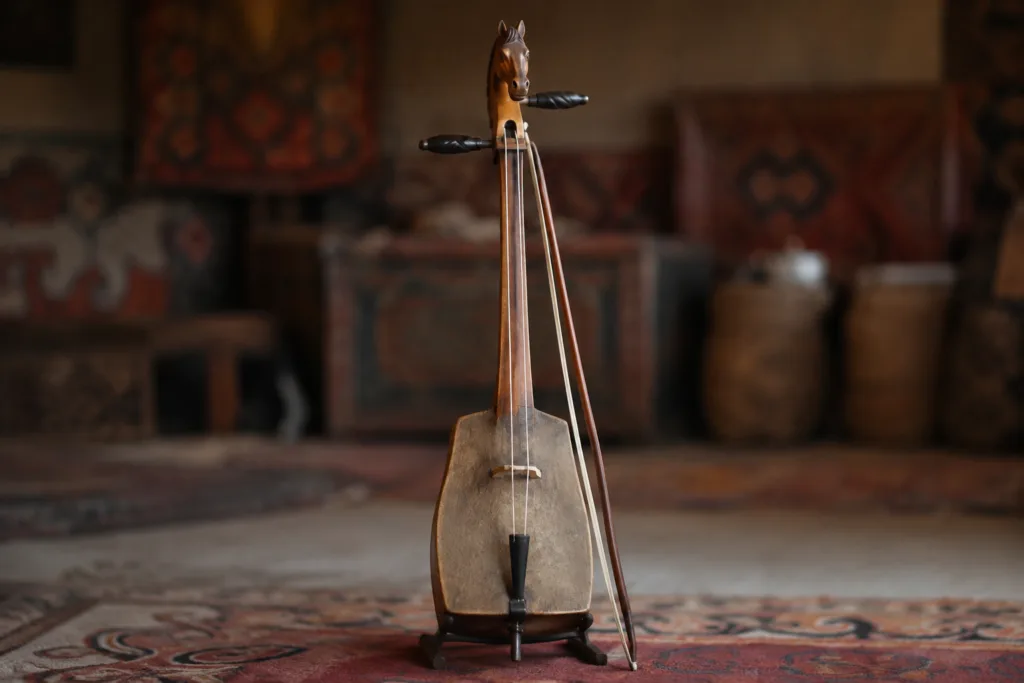
Tuvan Bowed Instrument
The igil is a two-string bowed fiddle from Tuva, a region of southern Siberia near Mongolia. Its long fretless neck, horsehair strings, loose-haired bow, and commonly teardrop-shaped resonator give it a construction and playing technique distinct from Western bowed strings. Many examples carry a carved horse head at the pegbox, yet the instrument’s identity rests just as much on its stringing, fingering, bowing, sound, and Tuvan musical tradition.
Two strings, traditionally made from bundles of horsehair.
Traditionally horsehair, with the player able to regulate hair tension during bowing.
Long and unfretted; the strings are touched lightly rather than firmly stopped against a fingerboard.
Often oval or teardrop-shaped. Goat-skin-faced and all-wood constructions are both documented.
A fifth between the strings is common. A fourth is also documented, and absolute pitch is not historically fixed to one standard.
Held nearly upright, commonly supported between or against the legs while bowed.
A Two-String Fiddle Built Around Horsehair
The igil belongs to the bowed string traditions of Inner Asia, yet its construction gives it a particularly Tuvan character. The name is often explained through the Tuvan expression iyi khyl, referring to two hairs or strings. That explanation matches one of the instrument’s defining materials: each traditional string consists of many horsehair strands gathered into a playable bundle rather than a single hair.
Horsehair also forms the bow hair. The resulting contact is therefore horsehair moving across horsehair, a combination that produces more surface texture than a smooth modern synthetic or metal string. The sound can carry audible bow grain, strong upper partials, soft-edged attacks, and sustained harmonic color.
The familiar carved horse at the top reinforces this relationship between material and imagery. It is common enough for the igil to be called a horse-head fiddle, although a horse carving alone cannot identify an instrument as an igil.
The Resonator Varies More Than the Familiar Silhouette Suggests
Many igils have a shallow teardrop or elongated oval body with a long neck rising directly from the resonator. Traditional makers may hollow the body from a block of wood rather than assemble it from thin ribs in the manner of a violin. Proportions vary because historical instrument making in Tuva did not depend on a single industrial template.
Skin-Faced Bodies
A common traditional construction uses stretched animal skin, especially goat skin, as the vibrating face of the resonator. The bridge rests on this membrane. Bow energy passes from the string into the bridge, then into the tensioned skin and the enclosed air space of the body.
A skin soundboard responds differently from a stiff wooden violin top. It can contribute a softer-edged attack and a more textured resonance, especially when paired with flexible horsehair strings. Skin also reacts to changes in humidity and tension, so setup and climate can affect response.
All-Wood Igils
Wood-faced and entirely wooden soundboxes are also documented. An igil should therefore not be rejected simply because its front lacks stretched skin. Maker practice, period, intended use, and later modification can all affect construction.
Oval, Teardrop, and Trapezoidal Forms
The rounded teardrop outline is the shape most closely associated with the instrument today. Trapezoidal examples have also been documented, including regional forms from parts of southern and eastern Tuva. Body outline is useful when examining an instrument, but it is not a dependable identification test by itself.
Construction Note: Exact length, body width, wood species, membrane thickness, soundhole pattern, and ornamentation are not standardized across all igils. A measurement taken from one museum specimen describes that particular instrument, not a universal Tuvan specification.
Why Horsehair Strings Behave Differently
A traditional igil string is made from dozens of individual horsehairs combined into a bundle. The bundle is flexible, microscopically uneven, and responsive to moisture. These properties affect how quickly the bow grips the string and how strongly different harmonics emerge.
The Bow Grips the Hair Bundle
Horsehair on the bow catches the horsehair string through friction. Bow speed, pressure, angle, and tension all alter the attack.
The String Drives the Bridge
The vibrating bundle transfers energy into the bridge. Changes in string tension and material can alter both response and harmonic balance.
The Bridge Excites the Soundboard
On a skin-faced instrument, the membrane flexes under the bridge and couples the string vibration to the resonating cavity.
The Body Shapes the Result
Body volume, wood, membrane tension, wall thickness, and sound openings influence projection, decay, and tonal focus.
The material also helps explain why the igil can produce so much color from only two strings. A player can emphasize a clean fundamental, expose upper harmonics, introduce controlled bow noise, or allow several partials to remain audible at once.
The Bow Has No Violin-Style Tensioning System
Traditional igil bows use loose horsehair rather than the tightly regulated ribbon found on a modern violin bow. The player can press against the hair with the fingers of the bowing hand, changing effective tension while playing.
This makes the bowing hand part of the tone-control system. A change in finger pressure can alter how firmly the hair engages the strings. Bow angle and torque can also shift the balance between a focused pitch and a more diffuse, overtone-heavy sound.
Descriptions of traditional technique commonly show an underhand bow grip, with the palm oriented upward. Individual technique varies, but the loose-hair principle remains an important difference between the igil and Western orchestral bows.
The Strings Are Touched Rather Than Pressed to a Fingerboard
An igil has no frets, and traditional technique does not depend on pressing the string firmly against a fingerboard to define every note. Players touch the string lightly from above or contact its side with a finger or fingernail. The string remains free enough to preserve a lively harmonic response.
This approach changes both pitch production and tone. Light contact can create ordinary stopped pitches, sliding inflections, or flageolet-like harmonics depending on the contact point and pressure. The left hand therefore controls more than note location; it also changes how much of the string’s overtone spectrum remains audible.
Common Confusion: Calling the igil a two-string violin can be useful as a very rough explanation of bowing, but it gives the wrong impression of the left-hand technique. Traditional igil playing does not rely on firmly pressing the strings against a violin-style fingerboard.
Tuning Is Based More on Relationship Than Fixed Concert Pitch
A fifth between the two strings is widely documented and is common in present-day performance. A fourth is also used. Historical practice did not require every igil to be tuned to the same pair of named pitches.
The interval between the strings supports open-string resonance and allows the player to move between melody, drone, and harmonics without a large set of strings. The open strings can remain audible beneath or between fingered tones, helping create the layered texture associated with Tuvan bowed music.
Traditional accounts also describe tuning in broader tension zones rather than as one mandatory concert pitch. Terms recorded for lower, middle, and tighter pitch levels reflect a practical approach in which the performer could choose a register appropriate to the instrument, voice, setting, or desired response.
| Tuning Element | Typical Practice | What It Changes |
|---|---|---|
| Interval between strings | Commonly a fifth; a fourth is also documented | Drone relationship, fingering range, harmonic interaction |
| Absolute pitch | Historically variable | Overall register and string tension |
| String tension | Adjusted for player, instrument, and musical setting | Response, resistance, projection, and tonal focus |
Its Sound Depends on Harmonics as Much as Melody
The igil can sound warm, grainy, woody, nasal, focused, or diffuse depending on the instrument and technique. Its most recognizable traditional character comes from sustained bowing, audible upper harmonics, flexible pitch inflection, and the interaction of open and lightly touched strings.
Tuvan musical thought gives unusual attention to timbre. One term associated with igil playing is xoyug, used for a soft or velvety quality. The instrumental genre known as uzun xoyug places extended tone, changing harmonic color, and sustained resonance ahead of fast melodic display.
During this type of playing, a listener may hear the fundamental remain stable while upper partials brighten, fade, or shift in prominence. Small movements of bow pressure and contact angle can produce large changes in tone without changing the written pitch.
That behavior helps explain why an apparently simple two-string construction can support a wide palette. The player is working with several layers of one vibrating sound rather than treating every note as a single, fixed tone.
Horsehair and Fishing Line Do Not Produce Exactly the Same Response
Modern players sometimes replace horsehair strings with fishing line or other synthetic filament. Synthetic material is more uniform, lasts longer, and is less sensitive to humidity. Those properties are useful for performers who travel through different climates or need predictable stage reliability.
Traditional horsehair remains acoustically distinct. Comparative work on igil strings has described horsehair as producing a warmer, fuller, more diffuse response, while fishing line can sound harder-edged and more focused. The difference comes from material behavior as well as the interaction between the bow hair and string surface.
| Property | Horsehair Bundle | Synthetic Filament |
|---|---|---|
| Surface | Made from many natural fibers with small irregularities | More uniform |
| Climate response | More affected by humidity | Usually more stable |
| Durability | Requires more attention and replacement | Often longer lasting |
| Tonal tendency | Can produce a broad, diffuse, warm texture | Can produce a tighter, more sharply defined response |
The choice is therefore more than a question of historical appearance. Changing string material alters playing resistance, stability, maintenance, and timbre.
Igil and Khöömei Work Through Related Overtone Ideas
The igil is often heard with Tuvan khöömei, or overtone singing. Their musical connection is especially clear when both performer and instrument emphasize partials above a sustained fundamental.
In khöömei, the singer shapes resonances of the vocal tract so particular overtones become prominent. On the igil, the performer can expose or suppress upper partials through fingering and bow control. When used together, voice and fiddle can occupy related harmonic territory without simply doubling the same melody.
The instrument can provide a drone, mirror part of a vocal phrase, answer the singer between lines, or sustain a contrasting layer of harmonics. Modern Tuvan ensembles have brought this combination to international concert stages, but the igil’s musical identity is broader than throat-singing accompaniment alone.
The Igil Also Belongs to Instrumental and Storytelling Traditions
Tuvan musicians have used the igil as a solo instrument, as accompaniment for singing, and in narrative performance. Accounts of traditional epic storytelling describe storytellers performing over a succession of evenings, sometimes accompanying the narrative with an igil. Instrumental accompaniment was possible rather than mandatory.
This context matters because the instrument can shape pacing without functioning like continuous Western chordal accompaniment. Sustained tones, brief phrases, drones, and changes in timbre can separate sections of a narrative or support recited and sung passages.
Older Tuvan instrumental practice also treated bowed music as an independent art. The igil could carry extended instrumental pieces centered on sound color and resonance, rather than serving only as support for a vocalist.
The Horse Head Is Culturally Visible but Organologically Insufficient
Many igils end in a carved horse head above the tuning pegs. Combined with horsehair strings and a horsehair bow, the carving creates an unusually direct material and visual association with the horse.
Horse imagery also appears in Tuvan stories connected with the instrument. Folklore should be treated as cultural tradition rather than literal evidence for a single historical invention event. Different tellings can explain the instrument through memory, symbolism, and relationships between people and horses without functioning as a dated construction record.
A carved horse head is also found on other Inner Asian instruments, most famously the Mongolian morin khuur. Identification therefore requires more than looking at the pegbox.
Common Confusion: A two-string fiddle with a horse carving is not automatically a morin khuur, and a horse-headed instrument is not automatically an igil. Body construction, regional origin, string material, bow arrangement, left-hand technique, terminology, and documented provenance all matter.
Why the Igil Is Not Simply a Smaller Morin Khuur
The igil and Mongolian morin khuur belong to neighboring horsehead-fiddle traditions and can look closely related. Both may have two strings, long necks, vertical playing positions, horsehair traditions, and carved horse pegboxes. Their similarities reflect connected Inner Asian musical cultures rather than proof that the instruments are interchangeable names for the same object.
| Feature | Igil Pattern | Identification Value |
|---|---|---|
| Cultural association | Tuva and Tuvan musical practice | Very informative when provenance is documented |
| Body outline | Often oval or teardrop-shaped; trapezoidal forms also exist | Helpful, but variable |
| Strings | Traditionally horsehair bundles | Strong construction clue |
| Soundboard | Goat skin common; all-wood forms documented | Useful only with other traits |
| Left-hand technique | Light contact rather than firm fingerboard stopping | Strong performance clue |
| Horse-head carving | Common | Weak when used alone |
Modernization Can Change More Than the Material
Attempts to adapt Tuvan bowed instruments to louder ensembles have sometimes replaced horsehair strings with metal strings. Higher string tension can then require changes elsewhere in the instrument, including a stronger wooden soundboard and a fingerboard suitable for firmly stopped strings.
Once those changes accumulate, the playing method also shifts. A metal string pressed onto a fingerboard responds differently from a horsehair bundle touched lightly from the side or above. Increased volume may come with changes in attack, overtone balance, bow resistance, and the tactile relationship between player and string.
Modern adaptation therefore ranges from small practical substitutions, such as fishing-line strings, to much deeper reconstruction. Two instruments carrying the same general name can behave very differently if string tension, soundboard material, neck design, and fingering method have all changed.
2009 Was Declared the Year of the Igil in Tuva
Tuva designated 2009 as the Year of the Igil. Activities connected with the program included instrument-making work, seminars, discussions, competitions, and efforts to preserve the techniques of experienced makers.
The emphasis on makers is especially relevant to the igil because the instrument historically allowed substantial individual variation. Preserving the tradition means retaining practical knowledge of wood selection, carving, membrane preparation, bridge setup, horsehair string making, bow construction, tuning, and performance technique.
Later craft initiatives in Kyzyl continued to support traditional instrument making and the training of younger builders. This living workshop culture helps explain why modern igils can retain older acoustic principles while differing visibly from one maker to another.
What to Examine on a Real Igil
An igil in a collection, shop, private archive, or museum should be examined as a complete construction system. Decorative appearance alone reveals very little about how the instrument was originally meant to function.
- Inspect the strings. Determine whether they are horsehair bundles, fishing line, another synthetic filament, metal, or a later replacement.
- Check the soundboard. Look for stretched skin, a wooden face, repairs, distortion around the bridge, and evidence of later reconstruction.
- Study the body profile. Rounded, teardrop, and more angular forms can all occur, so shape should be recorded rather than used as the sole label.
- Examine the neck. An original traditional setup should make sense with light string contact. A substantial modern fingerboard may indicate adaptation.
- Look at the bow. A loose-haired bow that allows finger-controlled tension fits traditional playing practice more closely than a Western screw-tension bow.
- Inspect the pegbox carving. Horse imagery can support identification, but carving style by itself does not establish Tuvan provenance.
- Check repairs before judging originality. Skin, strings, bridge, pegs, bow hair, and other working parts can be replaced during an instrument’s life.
- Separate age from playability. An older instrument may be culturally or historically valuable while requiring conservation rather than immediate restringing and performance.
Collector’s Note: A claimed “traditional igil” is more convincing when its materials, construction, playing setup, maker information, and Tuvan provenance support one another. A horse-head carving added to an otherwise unrelated bowed instrument is weak evidence on its own.