A frame drum can be little more than a wooden hoop and a stretched membrane, yet small differences in size, skin, construction, and playing technique give each tradition a distinct musical voice. The Irish bodhrán, North African bendir, Persian and Kurdish daf, Arabic tar, and related instruments share a basic structure without being interchangeable.
Some are played with a stick, others entirely with the hands. Some produce a dry pulse, while others ring, buzz, shimmer, or bend in pitch. Understanding these differences makes it easier to identify the instruments, judge their construction, and choose one suited to a particular musical setting.
What Is a Frame Drum?
A frame drum is a membranophone built around a relatively shallow circular frame. Its shell is usually much narrower than its diameter, distinguishing it from deeper cylindrical, barrel-shaped, and goblet drums.
The membrane may be made from goat, calf, deer, fish skin, or a synthetic material. Traditional heads are often attached permanently, while many modern instruments use internal tuning systems that allow the player to adjust tension.
Because the shell is shallow, much of the instrument’s character comes from the membrane and the player’s contact with it. Moving a hand closer to the center produces a different result from striking near the edge. Pressure applied from behind the head can also alter pitch, sustain, and resonance.
| Instrument | Associated Traditions | Typical Playing Method | Distinctive Character |
|---|---|---|---|
| Bodhrán | Irish traditional music | Tipper or hand, with rear-hand control | Deep pulse, dry attack, flexible pitch |
| Tar | Arabic and North African traditions | Hands and fingers | Open tones and clear finger articulation |
| Bendir | North Africa and surrounding regions | Hands and fingers | Warm resonance with a characteristic buzz |
| Daf or Daff | Persian, Kurdish, Arabic, Turkish, and Central Asian traditions | Hands, fingers, shakes, and rolling motions | Broad resonance, sometimes with internal rings |
| Riq | Arabic classical and folk music | Hands and fingers | Drum tones combined with metal jingles |
The Bodhrán and Its Changing Voice
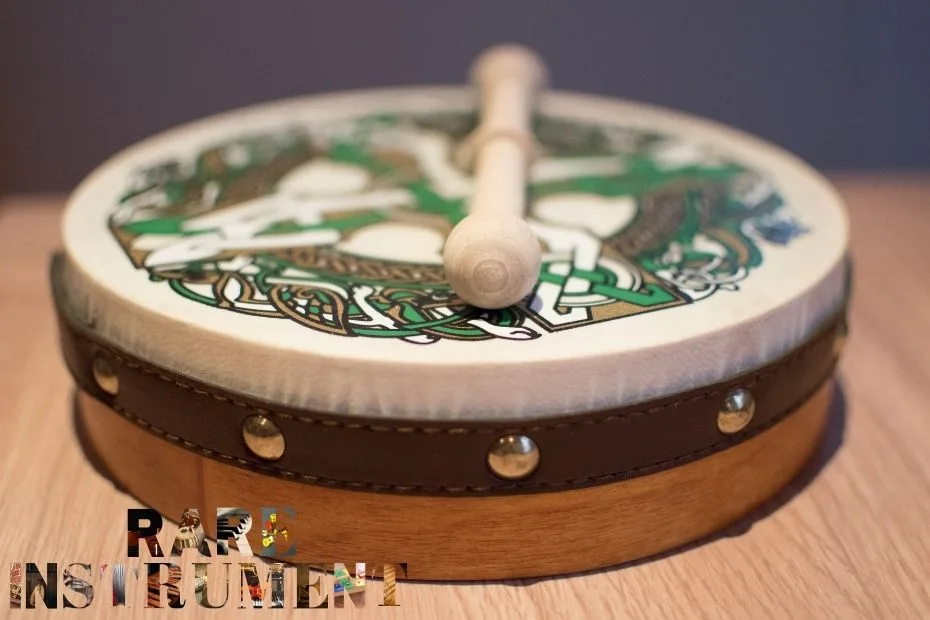
The bodhrán is the frame drum most closely associated with Irish traditional music. It is commonly held vertically against the body and played with a short beater known as a tipper. The supporting hand rests against the rear surface of the head, where it can dampen the membrane or alter its tension.
This rear-hand control is one of the bodhrán’s most recognizable features. By pressing, releasing, cupping, or sliding the hand, a player can move between a low open bass note and tighter, higher-pitched sounds. The drum can therefore support a melody with more tonal variation than its simple construction might suggest.
Modern bodhrán playing developed considerably during the twentieth century. Earlier instruments were often relatively large, shallow, non-tunable, and fitted with one or more wooden crossbars. Many contemporary player-grade bodhráns have open backs, deeper shells, internal tuning hardware, and carefully selected natural skins.
Bodhrán Construction
A bodhrán frame may be made from bent solid wood, laminated hardwood, or high-quality plywood. The most important qualities are roundness, stability, comfortable edges, and sufficient rigidity to support even membrane tension.
Goat skin remains a common choice for the head. Its natural variations can create a warm low register, a dry upper attack, and a responsive surface for pitch shaping. Synthetic heads are also available and are generally less sensitive to humidity.
Common construction features include:
- Internal tuning ring: Raises or lowers membrane tension.
- Open rear frame: Allows unrestricted movement of the supporting hand.
- Rounded bearing edge: Helps the head move freely and improves playing comfort.
- Deep shell: Can provide a more secure grip and a focused low-frequency response.
- Crossbar: Found mainly on traditional-style or decorative instruments.
Bodhrán Playing Technique
The tipper should normally be held with a relaxed grip. Much of the movement comes from the wrist rather than the whole arm. A clean stroke allows the beater to rebound from the membrane instead of remaining in contact and choking the sound.
Players may use one end of the tipper for a strong, traditional pulse or both ends for faster ornamentation. Modern top-end styles use small controlled movements near the upper part of the head, while broader strokes can produce a heavier dance rhythm.
The rear hand remains equally important. A flat palm creates greater damping, curved fingers preserve more resonance, and concentrated finger pressure raises pitch. Excessive pressure can make the membrane sound thin or lifeless, so effective control depends on allowing the head enough space to vibrate.
Tar: The Open-Hand Frame Drum
The Arabic tar is generally played with the hands rather than a separate beater. Its sound is shaped by finger placement, contact time, striking angle, and the distance between the stroke and the rim.
A central stroke can produce a lower and fuller tone, while fingers striking near the edge create a sharper response. Rolls, brushes, muted taps, and open releases allow the player to build detailed rhythmic phrases without relying on extreme volume.
Some tar drums have fixed natural-skin heads, while others use modern mechanical tuning systems. Certain instruments include a thumb opening in the frame to support a secure playing position.
Tar and Bodhrán Compared
| Feature | Bodhrán | Tar |
|---|---|---|
| Primary technique | Tipper strokes with rear-hand pitch control | Hand and finger strokes |
| Pitch shaping | Strongly influenced by pressure behind the head | Controlled mainly through stroke position and damping |
| Typical articulation | Deep bass, dry attack, controlled bends | Open low tones, bright edge notes, finger rolls |
| Common setting | Irish traditional sessions and folk arrangements | Arabic and North African rhythmic traditions |
The bodhrán often functions as a flexible bass-and-pulse instrument beneath a melody. The tar places greater emphasis on direct hand contact, finger detail, and changes in articulation across the playing surface.
Bendir, Daf, and Other Related Drums
Bendir
The bendir is widely associated with North African musical traditions. It is usually larger than a riq and may contain one or more strings stretched across the rear of the membrane. These strings vibrate against the head and create the instrument’s characteristic buzzing resonance.
This sound should not be mistaken for loose hardware or a damaged membrane. On a properly made bendir, the buzz is an intentional part of the instrument’s voice.
Daf and Daff
The daf belongs to a broad family of large frame drums found in Persian, Kurdish, Arabic, Turkish, Central Asian, and neighboring musical cultures. Construction and terminology vary considerably between regions.
Some instruments are plain frame drums, while others contain rows of metal rings attached inside the shell. These rings add a shimmering response when the drum is struck, tilted, shaken, or moved through rolling gestures.
Riq
The riq combines a small drumhead with pairs of metal jingles. Although it shares the circular frame of other instruments in this family, its playing vocabulary includes extensive control of both membrane and metal sounds.
A skilled player can isolate deep strokes, bright edge notes, muted attacks, jingle rolls, and combinations of drum and cymbal-like articulation. For this reason, the riq should not be treated merely as a simple tambourine.
Natural Skin and Synthetic Heads
The head material affects response, stability, texture, and maintenance. Natural skins have irregularities that can contribute warmth and tonal complexity, but they also respond strongly to changing environmental conditions.
| Head Material | Typical Qualities | Practical Considerations |
|---|---|---|
| Goat skin | Warm bass, lively texture, responsive pitch control | Sensitive to humidity and temperature |
| Calf skin | Round tone and relatively smooth response | Can feel heavier or less immediate |
| Deer skin | Soft attack and darker tonal color | Less common and highly dependent on preparation |
| Synthetic head | Consistent tension and predictable response | May offer less natural variation |
A natural head may loosen in a damp room and tighten in dry heat. A synthetic head is generally more stable during travel, outdoor performances, or rapid climate changes.
Neither material is automatically superior. The better choice depends on the player’s technique, climate, performance conditions, and preferred sound.
Tuning and Environmental Control
A tunable frame drum should be adjusted gradually and evenly. Large changes made at a single tuning point can create uneven tension and place unnecessary strain on the membrane or frame.
For a bodhrán, the most useful setting is rarely the highest possible tension. The head should remain loose enough to produce a full bass response while retaining enough definition for clean edge strokes and rear-hand pitch changes.
A practical tuning process is:
- Allow the drum to adjust to the room before making changes.
- Begin at a relatively low tension.
- Turn each adjuster in small, even increments.
- Check the center and edge tones after every pass.
- Test whether the rear hand can still bend the pitch smoothly.
Fixed-head instruments cannot be mechanically tuned. Their response is managed through storage, room conditions, hand technique, and careful acclimatization.
Direct heat should not be used casually to tighten a natural head. Excessive or uneven heating can damage the membrane, weaken adhesives, or distort the frame.
How Size and Depth Affect the Instrument
Diameter influences pitch, playing area, and the amount of air moved by the membrane. Larger drums often provide a broader low register, while smaller drums generally respond more quickly and produce sharper articulation.
Frame depth affects balance, grip, and the way the instrument sits against the body. A deeper bodhrán may feel secure and focused, but a poorly balanced deep shell can become tiring during a long session.
Size alone does not determine quality. A large drum with an uneven head may sound weak, while a smaller instrument with a carefully prepared membrane can produce a full and controlled tone.
Choosing the Right Frame Drum
The appropriate instrument depends first on the musical tradition and playing method.
- Choose a bodhrán for Irish traditional music, tipper technique, bass control, and rear-hand pitch movement.
- Choose a tar for direct hand playing, open tones, finger rolls, and Arabic or North African rhythmic vocabulary.
- Choose a bendir for a warm frame-drum sound combined with an intentional buzzing texture.
- Choose a daf for a broad resonant voice, especially when internal rings or large circular movements are part of the technique.
- Choose a riq when precise drum strokes and controlled metal-jingle articulation are both required.
Beginners may find a medium-sized, tunable instrument easier to manage. A tuning system reduces the effect of weather changes and allows the player to experiment with different tensions.
How to Evaluate Build Quality
A frame drum has relatively few components, which makes construction flaws easier to hear. The shell, membrane, bearing edge, and tuning hardware must work together evenly.
Before buying, examine the following areas:
- Shell roundness: The frame should not appear twisted, flattened, or warped.
- Membrane tension: Tapping around the head should not reveal severe dead spots.
- Edge comfort: The inner rim should not cut into the hand or wrist.
- Tuning hardware: Adjusters should move smoothly without rattling.
- Weight and balance: The drum should remain comfortable in its intended playing position.
- Head condition: Look for tears, loose attachment points, excessive dryness, or permanent sagging.
Decoration is not evidence of musical quality. A plain instrument with a stable shell and responsive head may perform better than an ornate drum made primarily for display.
Care and Storage
Natural-skin drums should be protected from sudden changes in temperature and humidity. Radiators, damp walls, direct sunlight, and hot vehicles can all damage the membrane or alter its tension.
- Allow the instrument to acclimate before playing or tuning.
- Use a padded or soft case during transport.
- Do not place heavy objects against the membrane.
- Wipe moisture and residue from the rim after playing.
- Keep tuning hardware clean and free from loose debris.
- Avoid applying oils, waxes, or conditioners unless the maker recommends a specific product.
Hands transfer moisture, salt, and natural oils to the membrane. This is especially noticeable on bodhráns because the supporting hand remains in constant contact with the inner surface.
Recording a Frame Drum
Microphone position should capture both the attack of the stroke and the body of the instrument. Placing a microphone directly in front of the center may exaggerate low frequencies, while positioning it too close to the rim can make the sound thin or papery.
A slightly off-center position often gives a more balanced result. Moving the microphone only a few centimeters can significantly change the recorded tone.
- Front and slightly off-center: Balanced attack and low-frequency body.
- Near the rim: Greater finger detail with less bass.
- Behind a bodhrán: Captures rear-hand damping and pitch movement.
- Room position: Useful for large daf or tar instruments in a suitable acoustic space.
For the bodhrán, the recording should preserve the movement created by the rear hand. For hand-played drums, the microphone should retain differences between open strokes, muted notes, brushes, and rolls.
Frequently Asked Questions
Is a bodhrán the same instrument as a tar?
No. Both belong to the frame-drum family, but they come from different musical traditions and use different playing techniques. The bodhrán is associated with Irish music and commonly uses a tipper. The Arabic tar is normally played with the hands and fingers.
Is the tar frame drum related to the Persian tar?
No. They share a transliterated name but belong to different instrument families. The Arabic tar discussed here is a drum, while the Persian and Azerbaijani tar is a plucked string instrument.
Are natural-skin heads better than synthetic heads?
Natural heads often provide greater tonal variation and organic texture. Synthetic heads are more stable in changing weather. The better option depends on performance conditions and personal preference.
What frame drum size is suitable for a beginner?
A medium-sized instrument is usually easier to hold while still producing a useful low register. For a first bodhrán, a tunable model can be more practical than a permanently fixed natural head.
Why does a bendir buzz?
Many bendirs contain strings stretched across the inside of the membrane. These strings vibrate against the head and deliberately create the instrument’s distinctive buzzing sound.
How can a warped frame affect the sound?
A warped shell can produce uneven membrane tension, unstable tuning, dead areas, and an uncomfortable playing position. Severe distortion may also make replacing the head difficult.