A Handy Snapshot 🌊
- What it is: an inharmonic acoustic instrument with a metal body and rods that sing, shimmer, and bend.
- What makes it special: a small amount of water inside the resonator adds a living, wavy motion to the sound.
- How it’s played: bowed, struck, or rubbed for everything from soft whispers to bold swells.
- Where it fits: sound design, contemporary music, and textural percussion setups.
- What to remember: treat it like a sound sculpture—keep it dry after use and store it carefully.
| Feature | What You’re Seeing | Why It Matters |
|---|---|---|
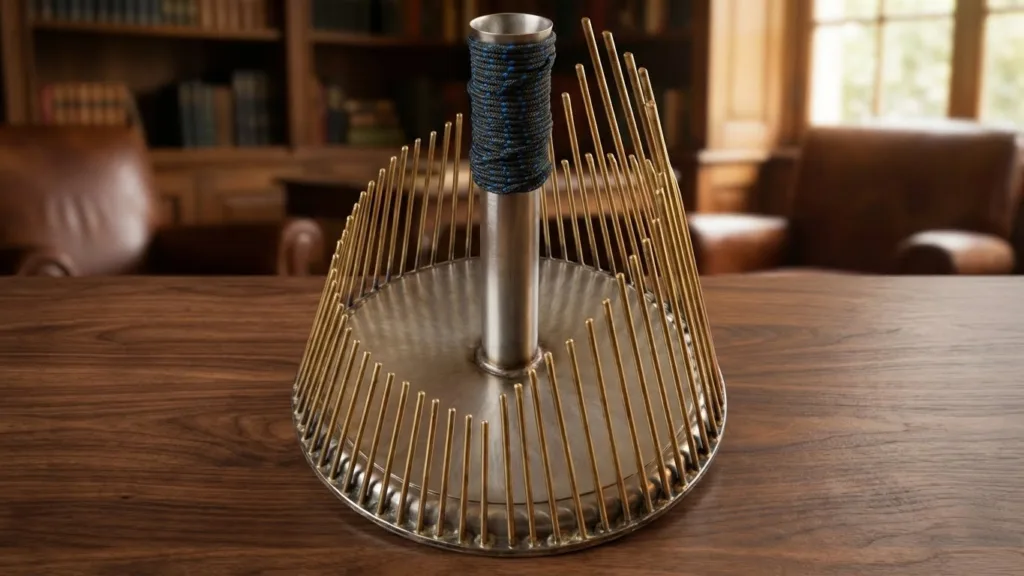
| Resonator Bowl 🥣 | Stainless steel bowl or pan with a sealed chamber | Defines the body of the sound and supports that rolling sustain |
| Neck / Port 🎺 | A small cylindrical neck for filling and resonance | Adds a projecting “voice” and shapes air movement |
| Tonal Rods 🔔 | Metal rods around the rim, often bronze, in varied lengths | Creates multiple pitches and overtones with a shifting spectrum |
| Water Amount 💧 | A small fill, not a full bowl | More water usually means more warble and less water means a cleaner ring |
| Playing Approach 🎻 | Bowing, mallets, fingertips, friction tools | One instrument, many textures—from gentle to dramatic |
What A Waterphone Is 🧭
- Family: a tuned idiophone—the body itself makes the sound, not strings or reeds.
- Personality: inharmonic and expressive, with tones that feel fluid instead of fixed.
- Nickname: you may hear ocean harp used for the same idea.
A waterphone is a compact instrument built for texture and movement. Instead of aiming for a neat scale, it leans into overtones, bends, and long, floating tails. That’s why it shows up so naturally in modern percussion rigs, experimental sets, and studio work where color matters as much as pitch.
If you’ve ever wanted a single object that can whisper, shimmer, and then suddenly bloom into a wide metallic choir, this is it. The sound comes from metal rods and a resonating chamber, and the little bit of water inside makes the whole thing feel alive.
How The Sound Forms 🎧
- Strike or bow the rods: you excite partial tones and complex overtones.
- The bowl amplifies: it adds body, bloom, and sustain.
- The water modulates: tiny waves inside shift the vibration and add motion.
The waterphone’s charm is the way it refuses to sit still. Bow a rod and you’ll hear a bright thread of sound, then a halo of overtones opens around it. Tilt the instrument and the water slides—suddenly the tone starts to waver, as if the pitch has a gentle tremble built in.
That “bending” feeling is why it works so well for mood. It can suggest distance, depth, and space without needing a lot of volume. In a quiet room, even a soft bow stroke can create a surprisingly big atmosphere.
Here’s a simple way to think about it: the rods provide the spark, the bowl provides the body, and the water provides the drift. Put together, you get that unmistakable metallic swim that feels both precise and untamed.
A Small “Sound Map” You Can Visualize 🧩
        (tonal rods)
     | | | | | | | |
   __|_|_|_|_|_|_|_|__
  /
 /   resonator bowl
    + small water        /
  __________  __________/
             ||
           neck/port
Touching different parts changes the response. The rods give pitch color, the bowl gives depth, and the water gives motion.
Origins, Name, And A Short Timeline 🕰️
- Inventor: American artist and instrument maker Richard Waters.
- Period: developed in the late 1960s.
- Patent: patented in 1975 (U.S. Patent 3,896,696).
The waterphone is a relatively modern classic. It was invented by Richard Waters in the late 1960s, and the design was later patented in 1975. Even today, it still feels fresh because it doesn’t copy a traditional instrument’s job; it creates its own lane where pitch and sound texture overlap.
The name is straightforward and kind of perfect: water + phone (sound). Some people also call it an ocean harp because the tone can resemble a wide, wave-like shimmer. It’s not trying to imitate the sea, but the motion and bloom can feel aquatic in a really natural way.
If you like instrument genealogy, the waterphone is often discussed alongside ideas from water drums, plucked metal tongues (like kalimba-style concepts), and bowed metal experiments such as nail-violin thinking. That mix helps explain why it can behave like percussion one moment and bowed sound sculpture the next.
Anatomy And Materials To Notice 🔍
- Body: commonly stainless steel for strength and stable resonance.
- Rods: often bronze, arranged at varying lengths for different tones.
- Build cues: clean welds, steady rod spacing, and a solid seal for the water chamber.
A waterphone appears simple, but its construction details are important. The resonator (usually stainless steel) must be rigid and properly formed to project a clear, sustained tone. The rods are typically bronze, and differences in their length and thickness produce a wide range of pitches rather than a fixed scale.
Rod attachment is a big deal. Secure mounting helps the instrument speak quickly, while uneven joins can dampen sustain or add unwanted buzz. A good waterphone lets you pull out delicate highs, deep mid growls, and swells that hang in the air with a strong resonanse.
Size also shapes personality. Many classic models are described in a small-to-large range (often labeled Standard, Whaler, Bass, and MegaBass). Larger bodies tend to give more low bloom and a broader wash, while smaller ones can feel quicker and more focused.
How To Play A Waterphone 🎻
- Bowing: smooth, singing tones with shifting harmonics.
- Striking: mallets and fingertips for attacks and bell-like decay.
- Friction: rub or drag tools for grainy textures and pulses.
Bowing Techniques
- Start light: a gentle bow pressure helps the rod speak without choking the tone.
- Change contact point: bowing higher or lower on a rod highlights different overtones and partials.
- Move the instrument: slow tilts shift the water and add natural motion.
Bowing is the signature move. With a rosined bow, you can draw a tone that feels like a cross between metal singing and a distant choir. Different rods respond differently, so even simple patterns can create a wide palette of colors.
Striking And Tapping
- Soft mallets: round tones with a gentle attack and long tails.
- Harder mallets: clearer ping and more definition.
- Fingertips: small, intimate articulations that feel close.
Striking brings out the instrument’s percussive side. A soft mallet can produce a warm wave of metal, while a firmer tool can add clarity and a more obvious pitch center. If you tap different rods quickly, you can create ripples that stack into a shimmering cluster.
Control: Water, Damping, And Motion 💧
- More water: more wobble and a softer, less direct center.
- Less water: cleaner sustain and a more stable ring.
- Damping: touch the bowl or rods to shape the decay.
The water level is your easiest “macro control.” A small change can noticeably alter how the sound breathes. With a modest fill, bowing can feel vocal and smooth; with a bit more water, the same stroke can turn into a drifting, chorus-like shimmer.
Damping is the next layer. Lightly touching a rod after it speaks can create short, bell-like phrases instead of long washes. Touching the resonator can tame harsh peaks and focus the tone. It’s a very hands-on instrument, and that’s part of the fun—you feel like you’re sculpting sound in real time.
A Practical Fill Habit ✅
- Use a small amount of clean water so you can hear the change without drowning the resonance.
- Keep a consistent starting point, then adjust by tiny amounts.
- Empty and dry after playing to keep the instrument happy.
Where You Hear It And Why It Works 🎬
- Film and TV: often used for mystery, tension, and unusual moments.
- Contemporary ensembles: fits beside gongs, bowed cymbals, and prepared sounds.
- Studios: prized for big results from small gestures.
The waterphone has a reputation in screen music because it can suggest “something is changing” without needing words. It’s not about volume; it’s about tone and motion. A single bowed note can bloom into a layered shimmer that feels like a scene shift, a reveal, or a strange space opening up behind the orchestra.
In live music, it’s equally at home in a percussion corner or a sound-art setup. Pair it with a gong and you get a deep metal bed plus a bright, moving halo. Pair it with strings and you get a contrast between stable pitch and fluid pitch. That contrast is gold when you’re building atmosphere.
Choosing A Waterphone For Your Setup 🧰
- Goal first: decide if you want more low bloom or more focused highs.
- Check response: each rod should speak clearly when bowed or tapped.
- Confirm comfort: stability, grip, and how it sits on a surface.
Start with the sound you want. If you’re chasing broad, slow waves, a larger resonator tends to help. If you want quick gestures and crisp highlights, a smaller size can feel more immediate. Neither is “better,” it’s just a different balance of weight, range, and response.
When you test one, try three quick checks: bow one rod lightly, strike a different rod softly, then tilt the instrument while a note sustains. You’re listening for clarity, smooth sustain, and a water motion that feels musical rather than random. A good instrument gives you control, not just surprise.
A Simple Buying Checklist
- Build: clean edges, secure rods, and a sturdy, sealed chamber.
- Noise floor: minimal rattles when you gently shake or tilt.
- Playability: rods speak with a light bow and don’t feel overly stiff.
- Practicality: easy to fill, easy to empty, easy to carry.
Care, Storage, And Long-Term Happiness 🧼
- After playing: empty the chamber and dry the instrument.
- Cleaning: gentle cloth, mild approach, avoid harsh chemicals.
- Storage: stable temperature, low humidity, and safe from knocks.
Water is part of the voice, but it shouldn’t live inside the instrument between sessions. Empty it, let it drain, and wipe the exterior dry. This simple habit supports the finish and keeps the metal looking clean. A little care makes the waterphone feel like a lifelong companion instead of a fragile curiosity.
For cleaning, keep it gentle. A soft cloth works for fingerprints, and a mild approach is usually enough. If you use a bow, keep rosin away from the bowl when possible, and wipe residue off rods so the surface stays consistent for smooth friction and response.
Storage is about stability. A padded case helps protect rods from bending and keeps the resonator safe. If you display it, choose a steady surface and give it a little space—this instrument is both a tool and a small piece of metal art, so treating it with respect just feels right .
Recording And Amplification Tips 🎙️
- Close + room: combine a close mic for detail and a room mic for space.
- Quiet dynamics: it records well at low volume with careful gain.
- Movement matters: tilting changes tone, so track with intention.
The waterphone loves microphones because its detail is rich. A close mic can capture the bow bite and tiny harmonic shifts, while a second mic a bit farther back can catch the bloom and air. If you only use one mic, aim for a spot that balances rod sparkle with resonator body; small moves can make a big difference in tone.
It also rewards gentle playing. You can create wide textures without being loud, which is great for intimate recordings. If you want extra clarity, record a few passes: one focused on bowed tones, another focused on struck accents, and a third focused on slow tilts for water motion. Layering these gives you a controlled, cinematic feel without needing heavy processing or tricks.
FAQ
Is A Waterphone Tuned To A Specific Key?
Most waterphones are built for inharmonic color rather than a single key. You’ll get recognizable pitch centers on certain rods, yet the magic is the shifting overtones and the way water motion changes the perceived tone.
How Much Water Should I Add?
A small amount is usually enough to create that wavy modulation. Start modest, listen, then adjust in tiny steps until the motion feels musical and easy to control.
What Kind Of Bow Works Well?
Many players use a rosined bow (often a violin or bass-style bow) because it grips the rods smoothly. The key is gentle pressure and steady speed so the rod speaks with a clean attack and a rich halo.
Can I Play It Quietly Without Losing Character?
Yes. Soft bow strokes and light taps can still produce a large sense of space because the instrument’s sustain carries so well. Close miking helps capture the fine details.
How Do I Prevent Corrosion Or Stains?
Empty the water after use and dry the instrument. A gentle wipe keeps fingerprints from lingering, and storing it in a stable, low-humidity spot protects the metal and keeps rods feeling smooth.
Is “Ocean Harp” The Same Thing?
In many contexts, ocean harp is a nickname for the waterphone. People use it because the sound can feel wave-like and wide, with a floating shimmer that suggests water motion.